On Counting to 16 (and Some Tips on Buying Eggs)

image of eggs

Since my blog last Friday, we lost one of our chickie girls. If you’ve been following my blog since the beginning, you’ll know this was tough to take. If you read my On Counting Your Chickens post, you’ll know how much I worried about losing a girl.

Chickie Girl #17 didn’t have a name because we can’t tell our Rhode Island Reds apart, and now that she’s gone, it seems even more tragic that she didn’t have a name. But she was loved as a part of my collective “girls” and loved with all of my heart. We do so much to protect our girls from predators and work so hard to give them a healthy, happy life that it was especially hard for me to take it that we lost her to a health problem she had related to laying eggs. She had a prolapsed vent, and, apparently, not all chickens die from this, but our girl did.

It was a sad night.

I was cooking a late supper, and my husband came to the kitchen door and said, “I think tonight might be the night.”

It was the night I had dreaded—and the night we spoke about so often. Our girls free range most days, and they just can’t stand it otherwise. And even though we do a “chicken count” many times a day, we will sometimes get busy and not count as much. So, when the girls come into their coop at night, it’s always an extra relief when you do your final count for the night and get 17. But, this night, there would be just 16.

I cried harder than probably a grown woman should, said goodbye to her as she lay in my husband’s arm, and watched as my husband buried her in the backyard near the woods, where the beloved pets of the previous owners of our house were laid to rest.

I wasn’t going to write about this experience. It seemed wrong, like I was exploiting her death. I also worried about sounding a little too much like the crazy chicken lady because I was so broken up over the death of one of our chickens. But something happened this week that made me think I really need to tell this story.

As I was mourning the death of Chickie Girl #17, I took a moment to mourn the bigger picture—the animals who are unfortunate enough to live on factory farms where they are abused and subjected to the most inhumane treatment. Our girl’s death reminded me to remember.

Then, this week, this story hit our local news about an egg factory farm here in Maine where the chickens are, apparently, living in deplorable conditions. According to the news, the state is now investigating, but, for me, this story is just another example, another reason why we, as consumers, need to force change with our pocketbooks.

I don’t want to be preachy, but factory farming in our country is awful for the animals and awful for us. I certainly won’t get on my soapbox about the conditions in factory farms for all animals, but I will do this: I want to share some options with my readers about getting eggs and share why I think these options are important. My goal is to be helpful and help spread the word about better alternatives to factory-farmed eggs.

First, if you can, it’s certainly best to buy eggs from a local farmer you know. Just driving to a friend’s house a few miles away on Route 9 yesterday, I saw several signs up from local farmers selling eggs. If you can see where the chickens live, that’s even better.
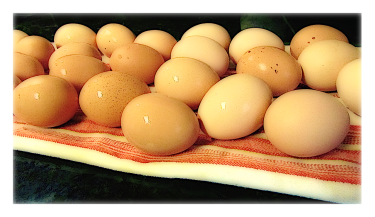
image of eggs
We have Rhode Island Reds, so all of our eggs are brown. But there is such variety in terms of shade, speckles, and shape. These are like little treasures to me, and we sell them to friends and neighbors, who also seem to appreciate these eggs.

It’s important that chickens are allowed to be chickens. They need to be able to spread out, be social, eat bugs, complain about the little things, like somebody else being in one certain nest box when five others are clearly available. If you live in Maine and are reading this blog, I’m guessing you probably even have a friend selling eggs. It seems like chickens are everywhere here. Take advantage of this.

If you don’t live in Maine, I want to share some links that might be helpful.

  • EatWild offers an interactive map to local farmers who raise grass-fed animals. The site does not guaranty each farm, but each farmer has signed a statement about the way their animals are raised in order to be listed with this organization.
  • Agrilicious.org is a site devoted to connecting people with local farmers. Local farmers and artisans can sign up to share information about their goods, and you, as a consumer, can get connected.
  • Of course, be sure to check out your local farmer’s markets. In addition to getting connected to local food and handmade goods, they are just fun. This site, from the USDA, lets you search for local farmer’s markets by your zip code.

If you’re busy and feel you don’t have time to buy local, then it’s important to be aware of what the labels mean on the egg cartons at the grocery story. “Cage Free” is not necessarily good, and most of the labels like “All Natural” don’t mean a thing at all. You want to look for “Certified Humane” and/or “Pasture Raised.” I found this great article from NPR that provides interpretations for all of those labels on your egg cartons. It’s a huge help.

Having chickens of my own has taught me just how unique and important each little life is. I still eat meat, but we are working very hard to only buy our meat from places where the animals are allowed to be animals and live a good life while they live—or raise the animals ourselves.

Our little chickie girls are funny, interesting, and each one is unique.
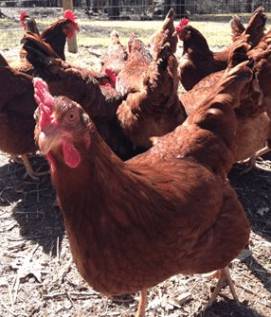
curious chicken
This is one of our curious girls. I was taking pictures of the chickens at snack time, but this little girl seemed way more interested in my camera.

Some are mama’s girls, some are daddy’s girls, and some are just their own girls. Some are scared of a new bowl, the baby ducks, and maybe their shadows. Some are way too bold, in my opinion.

Right now, we have a broody hen, who is so grumpy when we take her eggs, but we have to because we have no rooster yet. So my husband takes her grapes in the evenings, her favorite treats, and he talks to her while he reaches in and takes the eggs. She calms down when he talks to her. She lets him rub her little beak and head, and she talks back. I watch this in awe—two species, unable to communicate with each other, but the chickie girl seems to somehow understand my husband means her no harm. It’s a powerful sight to see.

It was a tough week for the Sands “Coop”eration with the loss of one of our girls, but I hope that telling her story can help just one more person decide not to buy eggs from a factory farm anymore.
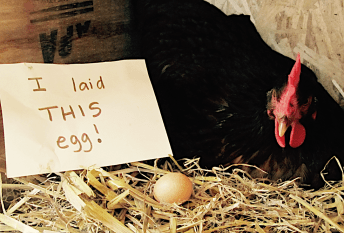
On Chicken Shaming

You may have seen the images of the chicken shaming that have been going around social media in the past few weeks, and I hope they made you smile as much as they made me smile. The one about the chicken who ate the mouse whole really made me giggle. I haven’t seen my girls do anything like that, but I have seen them take down some pretty large and pretty gross things, mainly fat grubs.

The images got me to thinking about my own girls’ behavior and how hilarious our chickens are. They make me laugh all the time, though they can also be a real pain sometimes, and those chicken shaming images made me want to share with the world how wonderful, awful, funny, and wild our chickie girls are.

Now, let me tell you, shaming your chickens is not as easy as it seems. I don’t know about other people’s chickens, but my girls are pretty tame. Yet the first time I tried to hang a sign on one’s neck, I felt like the worst chicken mama in the world! My poor sweet girl was so scared and seemed convinced the sign was going to be the death of her. Needless to say, this broke my heart and made me realize that I was going to have to find an easier way to shame my chickens and share their cuteness with the world.

I could only manage a few, as word spread quickly amongst the girls that mama was up to no good, so I could only put the signs I made near the “guilty” chickens in question. It worked pretty well overall, but I have many more stories to tell, like how the chickens have completely dug up our yard or how they moan and groan and squawk and cry to the high heavens until they are let out to free range each day.

But I’ve captured some of what it’s like to live with chickens, I think. I love these stinkers!

chicken with small egg

I don’t even know how this happens, but, a couple of times, one of the girls will lay a mini egg. It’s adorable but not worth much. There’s no yolk–at least there wasn’t a yolk in the first one we found. But, of course, I’m fine with a tiny egg every now and then. It’s just too funny that this happens.

This next one is Guineveve, and she’s one of our newer babies. She’s an ISA Brown, and we found out that this breed originated in France. Unlike our 17 Rhode Island Reds, each of the ISA Browns looks a little differently than the next one, so we’ve been able to name these girls.

Guinevieve is the most beautiful to me, but she’s also the most aloof. She lets us pet her, but she doesn’t come running to us like the other girls. And, most worrisome, she doesn’t seem to like hanging out with her sisters very much. She even roosts by herself at night.

Well, this week, we thought we’d lost her, our first loss. If you read my original post on counting chickens, you know how much I worry about losing one of our girls. Guinevieve seemed to be our first casualty this week.

It was time to put the little girls up for the night, and my husband said he could only find 7 of 8 baby girls. The girls are sleeping in the garage right now, so I was sure our chicken was somewhere in there. But, when I went outside and looked at the baby girls, I realized the missing girl was Guineveve! Considering her loner behavior, I thought maybe she was really gone.

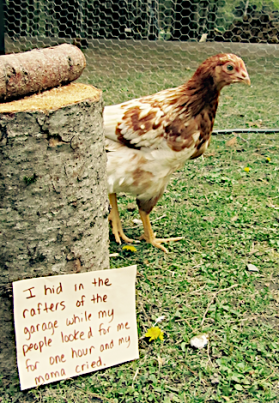
Hiding Chicken

I thought surely she had flown out of the open garage door and had been chased into the woods by one of the bigger chickens, only to be eaten by a fox, hawk, bobcat, or some monstrous, chicken-eating creature in our woods. It was getting late, and we looked for an hour with flashlights, calling for her. I was crying, and my husband seemed to feel so badly. I was trying so hard to tell myself that I had to deal with this kind of thing, that this kind of thing has happened to our neighbors times 10, times 20! I had to be tough.

I kept going back and looking in the garage, just to be safe, but still, just 7 of 8 little girls. But, then, after a little more hunting, my husband said, “I wonder if she’s still in the garage somehow,” and it dawned on me–I had not looked up really high. I just assumed she could not get up to the rafters in our garage.

Guess what! That’s where she was! When I opened the garage door, looked up, and saw her little white tail feathers, I was happy, relieved, and bemused that this little stinker had caused such a commotion. So we still have Guinevieve, but she’s getting shamed this week!

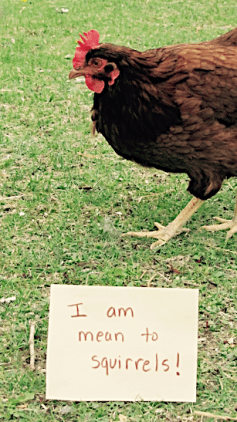
chickens with sign about squirrels

And, though I love our chickie girls more than I can say, I have to admit that the girls can often be stinkers–even a little mean. I have to stay on them and “be the rooster” sometimes, but, when they can, some of them will be little bullies. This spring, several of them have taken to bullying the poor little squirrels in order to take the seeds from the squirrels we feed. Or, perhaps, they do it out of spite because I see how enviously the chickens look at the squirrels when the squirrels are running free in the mornings while the chickens are still waiting to get out of their pen. I’m pretty sure those squirrels are getting the evil chicken eye.

So, this week, my mean girls get shamed as well!

Finally, after spending this morning “chicken shaming” and scaring some of my girls half to death with my little signs, my husband said that I should be shamed myself. I think he’s right. Our little chickie girls are sweet and beautiful and, sometimes, downright ornery, but I never want to make them feel badly. So my final sign is for me.

author shamed

And, since I wasn’t able to tell all of my girls’ ornery stories via pictures, I’ll just have to tell more stories in the weeks to come. If there’s one thing I’ve learned from raising chickens, it’s that those girls are always up to something and always completely entertaining!

On Making Friends

I’m an introvert in a pretty extreme way, and the older I get, the worse it seems to get. I mean, I can function when I have to, and for nearly twenty years, I stood in front of a classroom as a teacher. But it’s hard.

And, as an introvert, I always find it interesting that I both love people and feel drained by being around people. From my perspective, it’s definitely a myth that introverts don’t want to be around people. I’m so interested in people and love to hear their stories, but I get so nervous on the inside when I am around people that I end up being worn out from trying to pretend like I’m “normal.”

Interestingly, there are some people who can, somehow, actually add to my energy levels when I am around them—people who are warm, safe, and highly interesting to me. I wonder if they know who they are, if they know how wonderful they are to me. And, since I am not drained from being around them, I always wonder if I am draining them.

Anyway, since human-to-human friendships have been difficult for me, I have always been a good friend to animals. I remember loving animals a little more than the average kid when I was younger, but I was mainly just a dog person. As I have grown older, I have found great joy in just hanging out with animals and a greater variety of animals. It started with our first cat we adopted.

I’m allergic to cats, so I have never been around them too much, though I have always had a great admiration of them and always wanted one. When we moved to Maine and I learned that Maine Coon Cats are a little easier on people with allergies, I knew this was my solution to my conundrum. Then, I found out how much Maine Coon Cats cost, and I realized I had not really found my solution.

So, we just decided to find a cat that had some Maine Coon “leanings” and hope for the best. I was willing to take allergy meds if necessary. I really wanted a kitty.

One day, pretty much out of the blue, my husband said, “Let’s go see what they have at the Humane Society in the way of cats.” I was surprised but ready—and nervous. I didn’t know how to be around cats at all. My general impression of them was that they were more aloof than dogs and could be grumpy and less forgiving. That, plus my allergies, made me a little nervous, but I didn’t want to admit this to my husband. I had been considering a kitty for a long time. I thought this might be my chance.

When we arrived at the Humane Society in Bangor, Maine that day in February, they had one cat available for adoption. One cat! The rest were not ready for homes yet. I was like, “Well, let’s see this kitty!”

In the cage sat a beautiful but skinny kitty who definitely had some Maine Coon leanings, at least I thought—big feet, tufts on her ears and feet, and she was super soft. I decided to give her a test: I would give her a pet, and if she responded well, I figured she passed the test. I reached in to pet her, and she leaned in so hard to my petting that she fell off of the ledge she had been on. This was my cat! Love with gusto, even if it hurts sometimes!

Sophie the Cat
This is Sophie, who taught me that I’m an animal person–not just a dog person.

In the days after we brought her home, my allergies flared horribly, so I had to go on allergy meds. And, sadly, our beautiful kitty I named Sophie seemed terrified in our house. She hid in the basement a lot. But we hung in there, and we found that Sophie and I have one key thing in common—we love, love, love soft fuzzy things.

Enter my robe. Since it was February, I was wearing my robe around every morning and every evening. It’s a thick, soft, fleecy robe, and I soon realized that Sophie loved it. She would stay in my lap when I had on the robe. And, soon, she was kneading on my tummy and purring. It was a process, but Sophie and I fell in love with each other.

In the last year, I have also learned how to be friends with my chickens. I like to hang out with them and watch them do what they do. They are always busy and have so much personality. Now, I don’t want to give a false impression: We have 17 chickens, plus 8 baby chickens. Not all of them are sweet little birds. Some really are. Some are pretty ornery.

There’s one girl, the smallest of our original 17, who escapes the run, even when it’s not time for free range, runs around like mad, won’t let me pick her up in my arms like many of the others, and generally just drives me crazy. One time, I yelled at her that she was going to the chicken stew first, but then I felt really badly and decided this would not be true.

If you have been following my posts, you know that I hang out with animals a lot, maybe too much. I have found that even just watching the squirrels and birds at the feeders brings me great satisfaction. I’m convinced I have made friends with one of the red squirels in our yard. I still love people, but animals are way easier for me to hang out with. There’s no judgment, real or imaginary. At least I don’t think so.

And, hopefully, my kitties and my chickens are good with being my friends as well. Of course, I don’t know what’s going to happen when my chicky girls quit laying eggs. I’m not sure how I’m going to separate friendship from farming. I have been reading about it and trying to prepare myself. I think I can do it when it’s time, but I’m not sure.

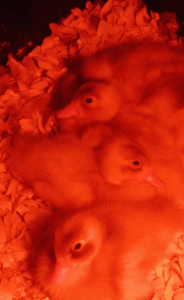
baby ducks
This week we welcomed 6 baby ducks–Indian Runner ducks–to help eat the bugs in our vegetable garden and, apparently, provide hours of entertainment. They are so fun!

For now, I have some really good friends to help me get through the days, to help me feel happiness and joy. In fact, this week, we added 6 animal friends—baby Indian Runner ducks, and they are hilarious. Already, I can’t wait to write stories about them! And, in the meantime, I think we should all take a lesson from Sophie–love with gusto!

On Spoiling Chickens

“If it’s possible to ruin a chicken in such a way, I’m sure you’ll do it.”

These are the words my husband spoke to me after I told him a story in which I was worried I was maybe spoiling our chickens a little too much.

Here’s what has happened of late:

Each morning, before I collect eggs, the chicky girls get a bagel, and it can be tricky to get 17 chickens to be “fair” when it comes to bites of bagel. I developed a system where I throw exactly 12 pieces into the middle of the chicken run, and while about 10 or 12 girls head to eat those, a handful hangout with me, knowing I will drop some at my feet for them. This plan has been working well for almost a year.

But I think the “spoiledness” reached new heights a couple of weeks ago. The girls who hang out at my feet for bagel bites will squawk at me until they get a bite of bagel, and I noticed that a couple of girls just kept squawking and looking at me hopefully, even though I had dropped bites of bagel on the ground right in front of them.

It looked like they wanted me to feed them directly, so I tried that. Guess what? It’s what they wanted!

But, then, because chickens are copy cats, like 3 or 4 other girls wanted the same treatment, so I was trying to get bites of bagels into beaks as quickly as I could and trying not to get my fingers pinched.

Thankfully, after about a week of this routine, the girls are now really good at aiming for bagel only and not my fingers, and it’s pretty adorable to see these girls jumping up like little chicken basketball players to get their bites out of my fingers. But, the sad reality is that I think our girls might be too spoiled.

This morning, I think things reached a new level. Today, I had about 6 or 7 little chicky girls, in a line, jumping up one at a time to get her bagel bite. The girls took turns, jumped up like little basketball-playing chickens, flapped their wings once for each jump, and looked so adorable I almost couldn’t believe it.

I have no idea how this just happened, but if I can get this to happen again (tomorrow, I am going to try to get my husband to film this), I have decided that I might need to take this show on the road—“Crystal and Her Amazingly Spoiled Chickens.”

image of chickens in coop
These were our girls in the coop this morning in the morning light after our little circus performance. They are so beautiful I don’t know how to not spoil them.

Still, my husband’s comment about how I will find a way to spoil animals as well as my experiences this week really got me to thinking about how this is happening. I mean, it would be much easier for me if these girls would just eat their bagel bites off of the ground. Is it okay that these girls are this spoiled?

So I spent a couple of weeks mulling this over, and after much thought about my thinking, I realized what might be at the root of my track record with spoiled animals.

If an animal is smart enough to communicate with me, an animal of a completely different species, its wants and needs, I feel it is important to reward such intelligence and skills. And, since science is proving all the time that animals are way smarter than people thought, smarter than I thought, I find myself with a lot of spoiled animals.

I will continue my reading on animal intelligence and maybe have to rethink my philosophy about how I approach our animals and their level of intelligence. I don’t think I have been giving them enough credit, and I had better do something. We have 8 more little girls growing up right now, and if I have to feed 25 chicky girls grapes and bagels individually, that’s going to be a job!

But I have to say that my husband is not a complete innocent here. One night this week, I caught him out in the garage with the baby girls. He was whistling a sweet tune to them and giving them the meal worms he bought from the pet store with each little baby jumping up to take a worm from his fingers. Indeed!

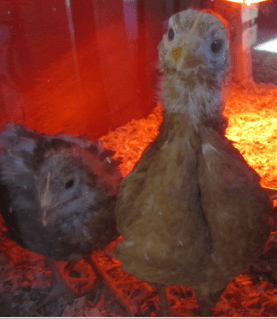
This is one of the baby girls now. I call this the "awkward teenage week" when they have some feathers but some fuzz. Still, they are cute beyond all reason, right?
This is one of the baby girls now. I call this the “awkward teenage weeks” when they have some feathers but some baby fluff as well. Still, they are cute beyond all reason, right? And, it’s really soon to tell for sure, but I think they may even be smarter than our first babies. These girls are ISA Browns–a cross between Rhode Island Reds, which we have already, and Rhode Island Whites.

It’s all coming together for me. I might know the root of the “feed me individual bites” thing. It’s not going to be easy not spoiling those chickens. Maybe I just need to be okay with spoiling them.