On the Best Chicken Stories from 2016

It seems 2016 was a big year for chickens. From chicken shaming to chicken sweaters, chickens have been in our hearts and on our minds in 2016. People all over the country are getting chickens for their farms, their backyards, and their homes. Chickens are the pets that poop breakfast, and we love them.

cute-chickens

We learned a lot of important chicken lessons in 2016. We learned from the CDC that we are not supposed to kiss our chickens. We learned about adorable chicken sweaters and then learned they weren’t a good idea. We learned a little bit more about just how intelligent these amazing little creatures are and that eggs are actually quite good for you.

As 2016 comes to an end, I thought it would be fun to take a look at some of the sweetest and most important chicken stories of the year.

1. We love our chickens a little too much and need to quit kissing them.

Because homestead, backyard, and even house chickens have become so popular, we learned this year from the CDC that salmonella cases are on the rise. This story from NPR summarizes the findings and tells us that we do need to stop kissing our chickens.

When I first read about the CDC report, I thought “I love my chickens, but I’ve never kissed them.” But, after thinking on it a bit, I remembered kissing a baby chick or two. I felt compelled to write a response in “On Kissing Chickens” and have given up my baby-chicken-kissing ways.

2. Chickens like to travel, too.

Without a doubt, the sweetest chicken story to come out of 2016 is the one about Monique, the seafaring chicken, who has travelled the world. In this story from the BBC, we learned about Monique and her travels with her owner, Guirec, from France. Monique provides breakfast and friendship, and in return, she gets to see the world. The video that accompanies this story is just the best, so if you haven’t seen it, check it out. Monique’s story has to be the feel-good chicken story of the year!

3. Chicken sweaters are adorable—but not such a great idea.

I don’t know how many times I was tagged in a Facebook post with pictures of chicken sweaters, and I have to admit that I wished I knew how to knit some little sweaters for my chicky girls. But it turns out that chicken sweaters are not so good for the chickens. Chickens don’t need sweaters. They do have feathers. And, apparently, putting your chickens in sweaters can do more harm than good.

So, even though those chickens in sweaters are cute beyond all reason, it’s best to resist. Chickens need to be able to preen themselves, and here’s a great post from Housewife Plus explaining both the trend and the reasons to resist.

As is often the case, Nature knows best.

4. Chicken shaming is a thing.

As chickens become more a part of our lives, we are learning just how much fun they are, and not to be outdone by dog and cat shaming, chicken shaming became a thing in 2016 as well. If you’re a chicken lover, chances are you’ve seen the chicken-shaming posts. There’s even an entire Facebook group devoted to chicken shaming. But it’s not so easy to get your chickens to pose for a shaming photo shoot, and I learned that the hard way in my own post on chicken shaming.

5. Chickens are wicked smart and full of personality.

Anyone who has kept chickens has known this one for a long time, but chicken intelligence got some great press this year. New research keeps adding to what we know about just how smart these chickens are. This piece from Modern Farmer, “The Inner Lives of Chickens” is a perfect example. It’s good for the world to know just how intelligent and interesting these birds are.

6. Eggs are really good for you.

And, while we really don’t need more reasons to keep chickens, new research was published this year emphasizing that eggs really are good for us. It used to be that we thought eggs were bad for us because of the cholesterol, but it turns out that eggs weren’t so bad after all. In fact, there’s a lot of nutrition packed into an egg. This piece from Time sheds some light on the egg debate. Fresh Eggs Daily also provides an excellent overview of the egg in this post.

One important thing to remember is that free range chicken eggs are much more nutritious than eggs from chickens in cages or even cage-free chickens. Chickens need space and to live like normal chickens for their eggs to be healthy, and I hope we continue to learn more about this in 2017.

If you’re a chicken lover like me, I’m sure you enjoyed all the press our little chicken friends have received this year, and we’ve certainly learned some valuable lessons. No kissing. No sweaters. And, if you plan to travel the world on a boat, a chicken can be a great shipmate.

Happy New Year, chicken friends!

On Chicken Treats in Winter

Winter is upon us, and I don’t know about your chickens, but most of our chickens are hesitant to leave the coop. “Snow. I’m not touching that stuff,” they seem to say.

But we have a few brave souls who will venture out, and, if our girls are anything like they were last year, eventually, most everyone will get cabin fever and have to venture out.

The winter months feel tough, and I worry about both boredom and health issues. The good news is that you can supplement a balanced chicken diet with some healthy and entertaining treats to help your backyard flock during our long Maine winters.

I created this winter treat infographic to share some treat ideas. But these are just a few ideas for healthy treats. What are your go-to healthy treats to keep your flock happy and healthy in the winter?

https://magic.piktochart.com/embed/18936278-winter-treats-for-chickens

On Rejecting the Food Industry: Processing Chickens and Finding Truths

A couple of weeks ago, I wrote about my anxiety surrounding our first “one bad day” as farmers. We had 14 chickens to process, and I had never experienced anything like it before. For me, it was a tough day. A long day. A draining day—and my husband did most of the work.

Still, that one bad day was profound for me, but I wanted to share my husband’s perspective with my readers because he bears the brunt of our farming endeavors so much more than I do. I invited him back for a guest blog post, and he writes about why we do what we do here.

We live in a world where most of us buy our lives from one store or another—the grocery store, the big-box, the mall conglomerate—ready-made and processed by others. Our appetites and desires are crafted and subtly honed; our satiation is often artificial and, at best, temporary, at worst potentially harmful. It is perfectly acceptable to mislead, obfuscate, and flat-out lie in this world. Television commercials, product labels and politicians do it all the time. Our truths are processed for us. The effectiveness of fact-checkers, like weather-forecasters, is subject to the winds.

Truth seemed different when I was young. When I was a boy, I had a step-grandmother. She kept a hatchet; the wooden handle was smooth and polished, and the edge on the head invariably was sharp enough to slice paper. We kept chickens; she came to help butcher the cockerels and old laying hens—she was a tough old bird herself. She would catch a chicken, grab it by the legs, flip it upside down, hold it until it settled, then lay it across the chopping block and whack! Her hatchet flashed like a guillotine. Sometimes, a headless bird would spring up and run, spewing blood around the yard, seemingly unwilling to accept the hardest of truths.

My step-grandmother was not a nurturing woman, but she was particularly grim on the days she butchered. She had no time for a foolish boy, and I did not understand her shortness. It took me many years to fully comprehend.

I left that world as an adult; I became busy, like most, with modern life and all its fixtures and conveniences. I moved with the times. But gradually, persistently, I started paying attention to where exactly “the times” where taking me. Terms like pesticides, preservatives, and factory farms began picking at the margins of my attention. I began to question the costs of my convenience, and with my wife, began to examine the modern truths.

We decided we no longer wanted to support agricultural systems designed around convenience for profit, where animals are abused and foods are poisoned with pesticides. We no longer wanted to support a food industry whose colorful and elaborate claims of health and nutrition form the foundational architecture for products propped up by preservatives and additives. So, as much as we could, we deliberately and steadily began moving away from this modern version of the truth.

We started with a garden. Each year we worked it, the area we planted grew—along with our vegetables—and our reliance upon the grocery store diminished. Three years after we started gardening, we bought chicks—Rhode Island Reds (stalwart layers)—and we began to collect eggs. My wife previously had insisted on buying eggs from cage free, humanely raised chickens. Having our own was a substantial cost savings. A year into raising laying hens, and subsequently increasing our flock with the addition of ISA Browns (the little French maids of laying hens), we bought a flock of Freedom Rangers—a type of broiler chicken.

Broiler chickens are also known by the anti-euphemism “meat-birds,” which is a truth that isn’t processed.

Ironically, the first batch of broilers were the friendliest chickens to date. I initially housed them in our garage in a brood-box I had fabricated out of scrap wood and old, closet doors. They quickly outgrew this arrangement, and I extended their garage area with a pallet enclosure bedded with straw. During this time, I also built a mobile chicken coop (not out of scrap wood and closet doors). I had it finished when the broilers were almost a month old and ready to move outside.

I wanted to keep them separate from the main flock, so I fenced an area approximately 1250 square feet about 50 feet from our back door, and I moved the broilers and their coop into it. There was some initial trepidation and some awkwardness among the fourteen young birds. The contrast between blue sky and 8-foot garage ceiling must have been somewhere north of tremendous. And the coop, being two-and-a-half feet off the ground, made for some precarious, initial forays down the ramp into the new world. Still, it didn’t take long before the fourteen were scratching and pecking and having their little chest-bumping show-downs over the new territory.

first-broilers
The Rangers always lined the fence to say hello.

We had deliberately attempted to humanize the Reds and Browns. But we did not with the Rangers, for obvious reasons. Despite this, the Rangers regularly crowded the fence whenever one of us came out the back door. I could walk among them without having them shy away as the Reds and Browns tended to. They often came to me instead, and I found, I could pet many of them if I wanted. This was before the treats started pouring out the back door.

Freedom Rangers finish in about 80 days, unlike the Cornish Cross broilers, which reach maturity in six to eight weeks and do little more than eat and excrete. The Rangers lead more of a “normal” chicken life, and I have read, taste better for it. The flip-side—in 80 days, I got to know them.

They were ready in mid-September, a few days before my birthday. I decided I would take care of business the weekend after. But I didn’t. I kept finding other, more urgent things to do, and it wasn’t until the morning of the 25th that I finally settled in to the task. I thought about my step-grandmother that day.

Like her, I am now a chicken serial killer. I slaughtered the fourteen—one after another. I held them by their feet, placed them in the killing cone, cut their jugulars, and then quickly pushed a knife through their palates into their brains. Each went instantly limp. It was one bad day for those chickens and one of many bad days for me. But there is truth in it.

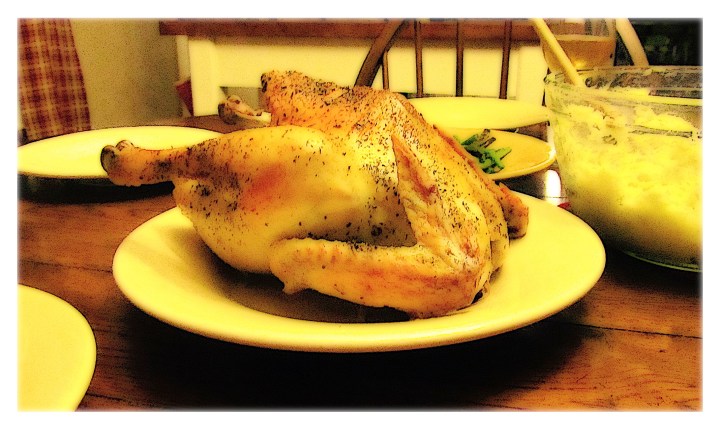
first-chicken-dinner
Everything we ate for this dinner came from our little farm–the chicken, the potatoes, and the beans. The food was so delicious, and we were grateful for all of it, especially the chicken.


It was late in the day when I asked my seven-year-old son to catch the final bird, which he did, his first involvement. He chased her around the pen then solemnly brought her to me. We talked over that final chicken, and he understood we should be grateful for, and respectful of, her sacrifice. We thanked her, as I had for each, and I explained that chickens do not have much of an opportunity to affect positive change in this world, but that he did. And she would help nourish him on his journey toward becoming a good man. There is truth in that too.