I’ve always been the kind of person who is hesitant about making New Year’s resolutions, but I made a couple last year that I mostly stuck to. This has me thinking I might try this again. Last year, I resolved to simplify my life and to eat more plants. Although I still have progress to be made in both areas, as we begin a new year, I realize I am doing better in terms of living simply and eating more plants.
With this in mind, I am trying this whole New Year’s resolution thing again.
For 2017, my big goal is to become more of a Maker. You may be wondering what it means to become a Maker, and it’s a pretty broad term. Essentially, just making some of the things you need instead of being a consumer makes you a Maker. But there are, of course, varying degrees of Maker-ness.
I have been working on this for some time, but a few goals have eluded me. I am hoping 2017 will be my year.
Here’s some of the progress I have made so far:
I learned to crochet scarves, and we really use them.
I cut everyone’s hair in our family, and I am not trained in this endeavor. I just watched, learned, and bought some really nice German scissors.
We raise chickens for eggs, and my husband raises some chickens for meat.
I make home-cooked meals for almost every meal. This has saved us a ton of money and had made us healthier.
My husband is relentless about repairing instead of replacing.
And these are my Maker goals for 2017:
Learn how to knit. I want to make socks and hats!
Re-learn how to can jams and jellies. About 15 years ago, I was taught how and did it a little, but I think I’m just going to have to re-learn this year.
Plant apple trees.
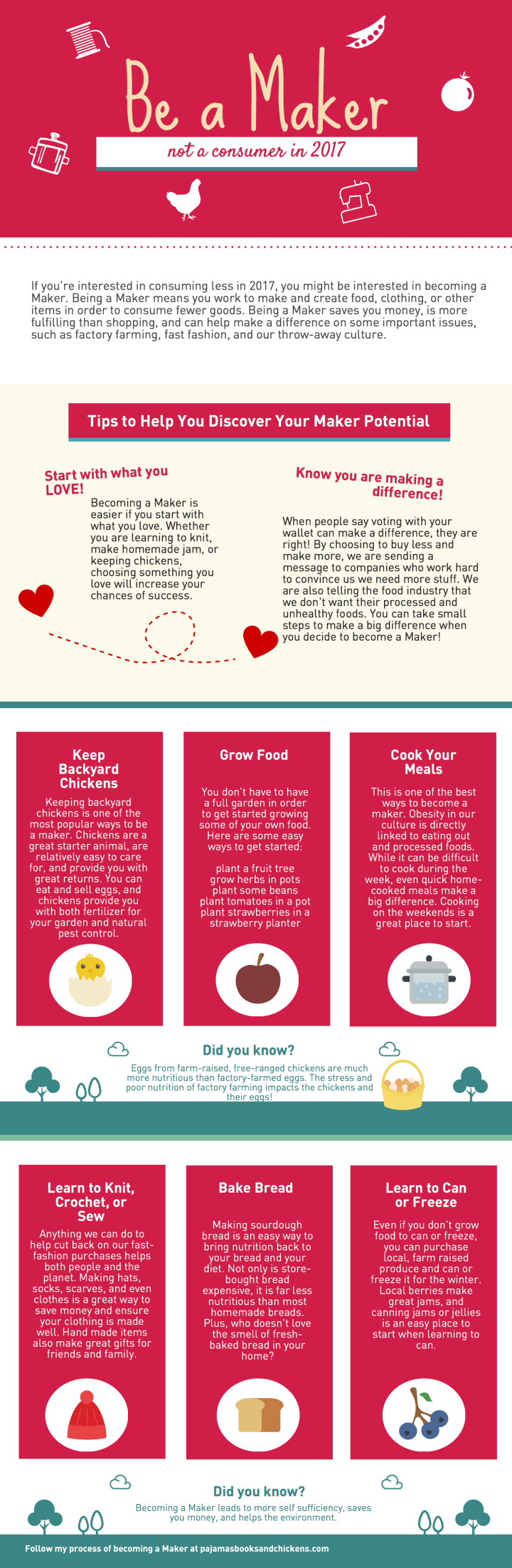
And, because I love infographics, I made one to emphasize some of the many benefits of becoming a Maker and trying to leave those consumer ways behind. I also have a few fun suggestions, but I would love to hear more.
It seems 2016 was a big year for chickens. From chicken shaming to chicken sweaters, chickens have been in our hearts and on our minds in 2016. People all over the country are getting chickens for their farms, their backyards, and their homes. Chickens are the pets that poop breakfast, and we love them.
We learned a lot of important chicken lessons in 2016. We learned from the CDC that we are not supposed to kiss our chickens. We learned about adorable chicken sweaters and then learned they weren’t a good idea. We learned a little bit more about just how intelligent these amazing little creatures are and that eggs are actually quite good for you.
As 2016 comes to an end, I thought it would be fun to take a look at some of the sweetest and most important chicken stories of the year.
1. We love our chickens a little too much and need to quit kissing them.
Because homestead, backyard, and even house chickens have become so popular, we learned this year from the CDC that salmonella cases are on the rise. This story from NPR summarizes the findings and tells us that we do need to stop kissing our chickens.
When I first read about the CDC report, I thought “I love my chickens, but I’ve never kissed them.” But, after thinking on it a bit, I remembered kissing a baby chick or two. I felt compelled to write a response in “On Kissing Chickens” and have given up my baby-chicken-kissing ways.
2. Chickens like to travel, too.
Without a doubt, the sweetest chicken story to come out of 2016 is the one about Monique, the seafaring chicken, who has travelled the world. In this story from the BBC, we learned about Monique and her travels with her owner, Guirec, from France. Monique provides breakfast and friendship, and in return, she gets to see the world. The video that accompanies this story is just the best, so if you haven’t seen it, check it out. Monique’s story has to be the feel-good chicken story of the year!
3. Chicken sweaters are adorable—but not such a great idea.
I don’t know how many times I was tagged in a Facebook post with pictures of chicken sweaters, and I have to admit that I wished I knew how to knit some little sweaters for my chicky girls. But it turns out that chicken sweaters are not so good for the chickens. Chickens don’t need sweaters. They do have feathers. And, apparently, putting your chickens in sweaters can do more harm than good.
So, even though those chickens in sweaters are cute beyond all reason, it’s best to resist. Chickens need to be able to preen themselves, and here’s a great post from Housewife Plus explaining both the trend and the reasons to resist.
As is often the case, Nature knows best.
4. Chicken shaming is a thing.
As chickens become more a part of our lives, we are learning just how much fun they are, and not to be outdone by dog and cat shaming, chicken shaming became a thing in 2016 as well. If you’re a chicken lover, chances are you’ve seen the chicken-shaming posts. There’s even an entire Facebook group devoted to chicken shaming. But it’s not so easy to get your chickens to pose for a shaming photo shoot, and I learned that the hard way in my own post on chicken shaming.
5. Chickens are wicked smart and full of personality.
Anyone who has kept chickens has known this one for a long time, but chicken intelligence got some great press this year. New research keeps adding to what we know about just how smart these chickens are. This piece from Modern Farmer, “The Inner Lives of Chickens” is a perfect example. It’s good for the world to know just how intelligent and interesting these birds are.
6. Eggs are really good for you.
And, while we really don’t need more reasons to keep chickens, new research was published this year emphasizing that eggs really are good for us. It used to be that we thought eggs were bad for us because of the cholesterol, but it turns out that eggs weren’t so bad after all. In fact, there’s a lot of nutrition packed into an egg. This piece from Time sheds some light on the egg debate. Fresh Eggs Daily also provides an excellent overview of the egg in this post.
One important thing to remember is that free range chicken eggs are much more nutritious than eggs from chickens in cages or even cage-free chickens. Chickens need space and to live like normal chickens for their eggs to be healthy, and I hope we continue to learn more about this in 2017.
If you’re a chicken lover like me, I’m sure you enjoyed all the press our little chicken friends have received this year, and we’ve certainly learned some valuable lessons. No kissing. No sweaters. And, if you plan to travel the world on a boat, a chicken can be a great shipmate.
It’s that time of year. The snow finally arrived here in Maine, and our chicky girls are laying fewer eggs. There’s still some molting going on, and the days are getting shorter and shorter. I saw a post on a chicken Facebook site (yes, we have those) that read “Let the freeloading begin.”
I had to giggle. Thinking about our girls as little freeloaders. I mean, they are certainly spoiled and very demanding. I can’t even walk out the front door without them running up and whining for a treat. But they do give us a delicious breakfast every morning, and with all the research about how beneficial eggs are to our diets, I think it’s okay if we have to support our girls a little as they molt and adjust to light changes. They can be little freeloaders if they need to be.
But shorter days and fewer eggs is a good reminder that we have to get our flock ready for the cooler weather, and after making it through our first fall and winter with our girls last year, I think I have some helpful tips from the lessons we learned based on both experience and lots of research online and in books.
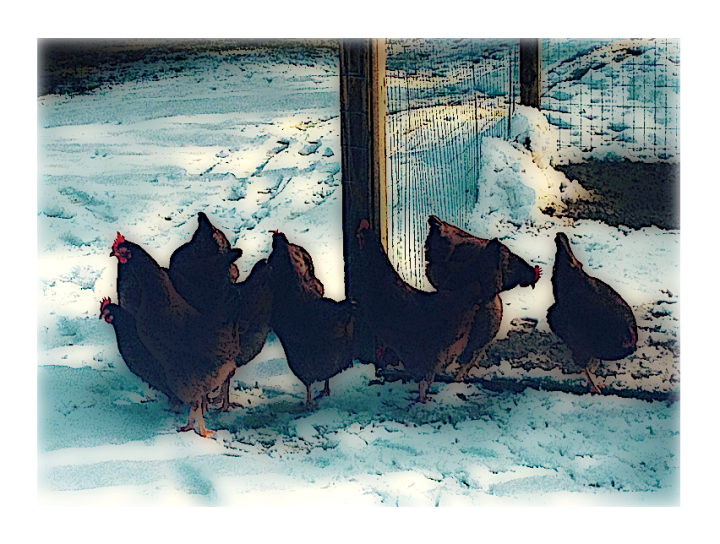
It took a little time, but our little Rhode Island Reds finally got brave enough to visit the snow!
1. Handling molting
If your girls are molting, they will lay fewer eggs, so try not to panic if you see egg production drop down suddenly right now. While they molt, it’s a good idea to give them some extra treats for their health. Sunflower seeds are a nice treat and can help their little bodies as they go through the molt. Of course, if yours are like mine and still molting a little even though the snow has arrived, make sure your girls have a warm place to go. I noticed our little girl who molted really hard hangs out in nest box quite a bit. Thankfully, the feathers are finally coming!
2. Thinking about light
You can supplement with light as the days get very short. This will keep your egg production from completely plummeting because chickens do need light to produce eggs. However, I read that you have to be careful with light supplements with young birds. It can lead to laying problems, apparently, if you supplement light when they are too young.
Most of our girls are in their second year now, so my husband just started supplementing with a light that is on a timer in the coop. He has it set to give the girls an extra hour and a half of light each day. The egg production right now is still not nearly what it was this summer with those long, lovely days, but we at least have enough for breakfast every day and a little sharing.
3. Keeping clean, fresh water
When it starts to get really cold, water will freeze, so you really, really have to stay on top of the water thing. Some people get heaters for the water. That is a great idea. We have an insulated coop, plus the girls put out a lot of heat, so we haven’t had to use a water heater. However, a water heater would work best if you don’t have enough warmth in your coop. And you have to make sure the water is fresh and clean every single day. Even during the winter, clean water really is the most important ingredient to chicken health.
4. Preventing chicken boredom
Be aware of chicken boredom in the winter months because it’s a real thing and will cause your girls to be mean to each other. Your chickens could get hurt. Our girls go from free ranging everywhere to only having their coop, a run, and some paths my husband shovels. We also have a few girls who do not want to go out when it’s snowy at all. So we have to find ways to get them some space and some things to do.
One thing you can do is just make sure they get as much space as possible in the snow. They really do need to get outside to play, even when it’s cold.My husband was great about shoveling our girls’ run, and we read this year about saving the leaves from your trees this fall in bags and spreading them in the snow for your chickens to walk on and peck around in. This is actually the best tip I can share. It’s genius. It gives a great use for your leaves and will really help your chicky girls. Our girls have loved this so far, and it’s the only we’ve been able to coax some of them out of the coop since they are a little worried about this first snow.
But you can also give your chickens different kinds of treats to keep them busy. Check out my infographic here for more information.
Just make sure they are healthy treats, and, of course, always keep a balanced diet in mind. But, last winter, we would share fruit and vegetable scraps, and the variety was good. Working on the fruits and veggies also kept the girls busy.
5. Protecting their combs
And, when you let your girls outside to play in the winter, you should keep an eye on their combs. If you have chickens with large combs, it’s a good idea to put some petroleum jelly on them to help keep them safe in the winter cold.
6. Preparing for the deep freeze
Finally, if you haven’t done this already, it’s a good time to start thinking about how to winterize your coop. Just as we work on winterizing our homes here in Maine, it’s important to think about the temperatures for our chickens during the long winter months and what you will do during those long cold nights.
First, it’s important to keep in mind that chickens, depending upon how many you have, do put out some heat all on their own, so you may not have much winterizing to do, depending on how many chickens you have.
You may not need to insulate your coop, but, if you do, make sure your coop has proper ventilation. This is really key. You may think that keeping out the cold is the most important thing, but you also have to keep ventilation in mind. Chickens can get serious respiratory illnesses, and no one wants that.
According to my research, chickens can be okay and temps down to about 0 degrees Fahrenheit (and maybe a little lower, depending upon breed), so I recommend just keeping a thermometer in your coop to allow you to keep an eye on things.
Our coop is insulated, so we only had to heat our coop a couple of times last winter, though some people will argue you don’t have to heat at all. In fact, unless you are really careful, it may be best not to heat. My husband built a cage to go around a small oil heater, so it didn’t put out much heat and was safe for our girls. It just kept temps above 0 degrees during the worst nights of February.
This is, of course, not an exhaustive list but should help you starting thinking about adjusting to the cooler temps. If you have other tips or advice, please share in the comments section. It would be great to hear your tips as well!
Winter is upon us, and I don’t know about your chickens, but most of our chickens are hesitant to leave the coop. “Snow. I’m not touching that stuff,” they seem to say.
But we have a few brave souls who will venture out, and, if our girls are anything like they were last year, eventually, most everyone will get cabin fever and have to venture out.
The winter months feel tough, and I worry about both boredom and health issues. The good news is that you can supplement a balanced chicken diet with some healthy and entertaining treats to help your backyard flock during our long Maine winters.
I created this winter treat infographic to share some treat ideas. But these are just a few ideas for healthy treats. What are your go-to healthy treats to keep your flock happy and healthy in the winter?
I’ve tried three times in my life to be a vegetarian. The longest I ever made it without eating meat was about 9 months. One day, I just couldn’t take it anymore. I went to a local burger joint and scarfed a giant cheeseburger. It was so good, and though I felt quite guilty, I decided that this would be the last time I tried to be a vegetarian. I’m just a darn omnivore, I suppose.
The reason I wanted to become a vegetarian is pretty simple: I love animals and didn’t want to eat them. Even now, ten years after my last attempt at becoming a vegetarian, part of me doesn’t want to eat animals, and that’s making this weekend an extra difficult one for this wannabe chicken farmer.
Earlier this summer, my husband and I purchased some broiler chickens as a part of our efforts to become more self-sufficient and frugal. We didn’t purchase the Cornish Cross chickens because they seem to have a lot of problems related to growing too quickly. We wanted a bird that could get around and have a good life—right up until his or her “one bad day.”
So we purchased some Freedom Ranger chicks and have had good luck. They take longer to develop than the Cornish Crosses, so they are not as much of a cost-saver. However, according to some experts, the meat tastes better because they can live a natural chicken life. We’ve not lost any birds to health issues or predators, and, well, unless something happens today, we’ll have had success in raising them.
This is the biggest rooster of the Freedom Ranger bunch, and he’s pretty magnificent and only a couple months old. I’m convinced he’s looking at me here like he knows what’s up.
Tomorrow is their “one bad day.”
My husband and I picked up this expression after watching a Michael Pollan documentary. In the film, a pig farmer discussed her struggles killing her pigs that she has cared for so much. She admitted to having a hard time, but she focused on making the pigs’ lives really good ones so that they just had “one bad day,” the day of their deaths.
This seemed profound to me, and my husband and I have made this our focus. We have worked to make sure they have had good lives.
The birds we have are pretty tame and curious and busy, and they also learned quickly how to get what they want from me and my husband, especially my husband.
As an aside, in an effort to protect me, my husband has done most of the raising of the broilers. I mostly handle the layers; they get to be my babies. And my husband mostly handles the birds for meat.
So my husband, who is definitely a believer in the good life until the “one bad day,” has taken those chickens more scones than I can count and has ensured they’re never without fresh food, water, and a clean place to live and play.
But, this weekend, the “one bad day” is upon us, and there’s definitely a tension in the air.
When we first decided we wanted to be hobby farmers, I did a lot of reading about farmers who love animals, eat meat, and struggle emotionally with the killing of their animals. It seems it’s quite common for the dread to creep in the days before “processing.” That’s where we are. Tomorrow is the day.
My husband says I don’t have to help, but I want to. First of all, it’s a lot of work, and this whole “self-sufficient farm thing” was my idea too. I don’t work outside the home as much as I used to, not nearly so much, so I do see the work on our hobby farm as my responsibility as well. But, second, it feels important to me. I feel like I should mourn those birds. I feel like I should have to know where my dinner is coming from and what the costs of it are.
I don’t know how much I’ll be able to write about it. I’m pretty sure I won’t be able to be the blogger who provides the step-by-step support for the process, as some helpful bloggers do—at least not for some time. But I hope to share what it feels like emotionally, and I do hope to be able to share some tips about things people can do to ensure a humane death for their chickens. We have done a lot of research. We’ll see how it goes tomorrow.
If nothing else, a goal I have for my writing is to help raise awareness about our food we eat. It’s way too easy not to think about where our food comes from. I think we should have to think about it, at least some. I think we should give thanks to the animals.
And we’ll see how I do with this. This time next week, I may be on another quest to become a vegetarian. I really hope not.
One day last week, a little girl from our neighborhood was at our house playing with our youngest son when she saw the coop for the broilers and asked why it was smaller. “How will they have room to lay eggs?” she asked. I told her that these birds would never lay eggs, that they were for meat. I worried about how she might take it.
“It’s a little sad, yes?” I asked her.
“It is,” she said, “but at least you’ll have food.”
This week was a big week for the Sands “Coop”eration. My husband built a mobile chicken coop for our broilers we purchased last month. The babies had been living in the brood box but were big enough to make the move outside, and we needed something sturdy for them to sleep in at night. We do live near the woods after all!
We are learning to be a little more self-sufficient all the time, and since we’re not vegetarians (I have tried and failed several times), we decided to get broilers or “meat birds.” We believe that, if we’re going to eat meat, we should know where it comes from. And, we’re taking it one step further and doing it ourselves.
At least that’s the plan.
It’s not going to be easy to kill our own food, but I’ll write and worry more about that another day. We’ve been watching videos and reading about humane and respectful deaths for chickens, but, for now, I’ll just say that I’ve tried to be very careful not to get too attached to the broilers.
Food; water; how are you doing? In and out.
Unfortunately, these birds are extremely docile and friendly, much more so than our Rhode Island Reds and ISA Browns. Our layers are more mistrustful, and you have to earn their trust. The little broilers just come right up to you, all sweet and curious.
Thanks, universe, for making this even harder. Just what I needed, right?
But we are, of course, of the notion that we want these birds to live a merry life, though it will be a short one, so my husband built them some nice accommodations this week, complete with wheels, so they can move to different parts of the yard and explore new areas.
This week, I share some of his process and the beautiful end results.
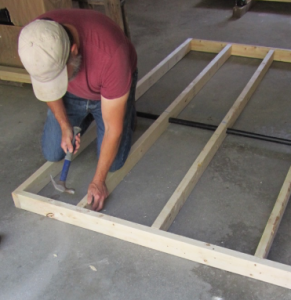
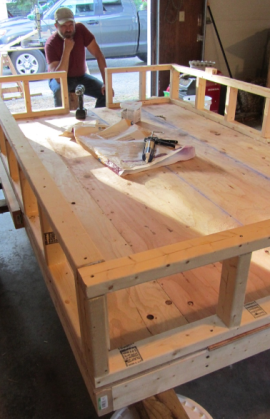
Here, my husband is just getting it started. As someone who can’t build a thing, I’m so amazed that this is the beginning of something so substantial.
My husband has framed out the bottom of the coop here. In an effort to be frugal, he used a lot of parts and scraps he had around. The “mobile” part of the coop was built in an axle he created. He used our son’s old bicycle wheels for the “mobile” part of the coop.
And it’s looking like a chicken house!
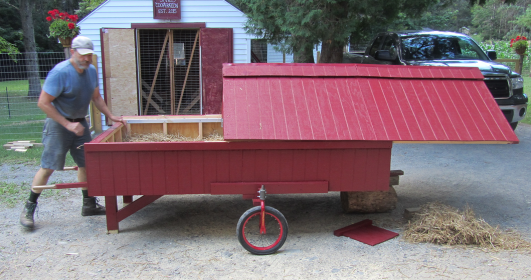
Here it is finished and in action. My husband very creatively built a slider system to make it easier to get into the coop for cleaning and feeding and watering. He used shower rollers on the roof for the rolling. I’m pretty sure he could have been an engineer.
And here’s the mobile coop being mobile. Of course, our youngest had to help, and he was a great help. He helped scoop up almost every one of those chickens.
Here are the chickens with their new home. My husband built a large temporary run and even a little gate. The chickens seem to be in heaven out there!
Ultimately, it seems like a beautiful little place to be a little chicken. The chickens run around during the day and sleep in their sturdy little red house at night.
I think we need a sign above the door though, like the one we have over the door of our main chicken coop, but I don’t know what it should say. The grim part of me thinks it should read “Lasciate ogne speranza, voi ch’intrate” or “Abandon all hope ye who enter here.” I mean, I know what’s coming. I’m a little worried and have a bit of dread.
But I think my husband’s idea is better: “It’s a merry life but a short one.”
I’ll keep you posted. In the meantime, my husband just kind of invented his way around in creating this mobile chicken house, but if you’re interested in building your own, here are some resources.
Since my blog last Friday, we lost one of our chickie girls. If you’ve been following my blog since the beginning, you’ll know this was tough to take. If you read my On Counting Your Chickens post, you’ll know how much I worried about losing a girl.
Chickie Girl #17 didn’t have a name because we can’t tell our Rhode Island Reds apart, and now that she’s gone, it seems even more tragic that she didn’t have a name. But she was loved as a part of my collective “girls” and loved with all of my heart. We do so much to protect our girls from predators and work so hard to give them a healthy, happy life that it was especially hard for me to take it that we lost her to a health problem she had related to laying eggs. She had a prolapsed vent, and, apparently, not all chickens die from this, but our girl did.
It was a sad night.
I was cooking a late supper, and my husband came to the kitchen door and said, “I think tonight might be the night.”
It was the night I had dreaded—and the night we spoke about so often. Our girls free range most days, and they just can’t stand it otherwise. And even though we do a “chicken count” many times a day, we will sometimes get busy and not count as much. So, when the girls come into their coop at night, it’s always an extra relief when you do your final count for the night and get 17. But, this night, there would be just 16.
I cried harder than probably a grown woman should, said goodbye to her as she lay in my husband’s arm, and watched as my husband buried her in the backyard near the woods, where the beloved pets of the previous owners of our house were laid to rest.
I wasn’t going to write about this experience. It seemed wrong, like I was exploiting her death. I also worried about sounding a little too much like the crazy chicken lady because I was so broken up over the death of one of our chickens. But something happened this week that made me think I really need to tell this story.
As I was mourning the death of Chickie Girl #17, I took a moment to mourn the bigger picture—the animals who are unfortunate enough to live on factory farms where they are abused and subjected to the most inhumane treatment. Our girl’s death reminded me to remember.
Then, this week, this story hit our local news about an egg factory farm here in Maine where the chickens are, apparently, living in deplorable conditions. According to the news, the state is now investigating, but, for me, this story is just another example, another reason why we, as consumers, need to force change with our pocketbooks.
I don’t want to be preachy, but factory farming in our country is awful for the animals and awful for us. I certainly won’t get on my soapbox about the conditions in factory farms for all animals, but I will do this: I want to share some options with my readers about getting eggs and share why I think these options are important. My goal is to be helpful and help spread the word about better alternatives to factory-farmed eggs.
First, if you can, it’s certainly best to buy eggs from a local farmer you know. Just driving to a friend’s house a few miles away on Route 9 yesterday, I saw several signs up from local farmers selling eggs. If you can see where the chickens live, that’s even better.
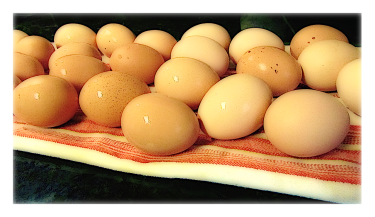
We have Rhode Island Reds, so all of our eggs are brown. But there is such variety in terms of shade, speckles, and shape. These are like little treasures to me, and we sell them to friends and neighbors, who also seem to appreciate these eggs.
It’s important that chickens are allowed to be chickens. They need to be able to spread out, be social, eat bugs, complain about the little things, like somebody else being in one certain nest box when five others are clearly available. If you live in Maine and are reading this blog, I’m guessing you probably even have a friend selling eggs. It seems like chickens are everywhere here. Take advantage of this.
If you don’t live in Maine, I want to share some links that might be helpful.
EatWild offers an interactive map to local farmers who raise grass-fed animals. The site does not guaranty each farm, but each farmer has signed a statement about the way their animals are raised in order to be listed with this organization.
Agrilicious.org is a site devoted to connecting people with local farmers. Local farmers and artisans can sign up to share information about their goods, and you, as a consumer, can get connected.
Of course, be sure to check out your local farmer’s markets. In addition to getting connected to local food and handmade goods, they are just fun. This site, from the USDA, lets you search for local farmer’s markets by your zip code.
If you’re busy and feel you don’t have time to buy local, then it’s important to be aware of what the labels mean on the egg cartons at the grocery story. “Cage Free” is not necessarily good, and most of the labels like “All Natural” don’t mean a thing at all. You want to look for “Certified Humane” and/or “Pasture Raised.” I found this great article from NPR that provides interpretations for all of those labels on your egg cartons. It’s a huge help.
Having chickens of my own has taught me just how unique and important each little life is. I still eat meat, but we are working very hard to only buy our meat from places where the animals are allowed to be animals and live a good life while they live—or raise the animals ourselves.
Our little chickie girls are funny, interesting, and each one is unique.
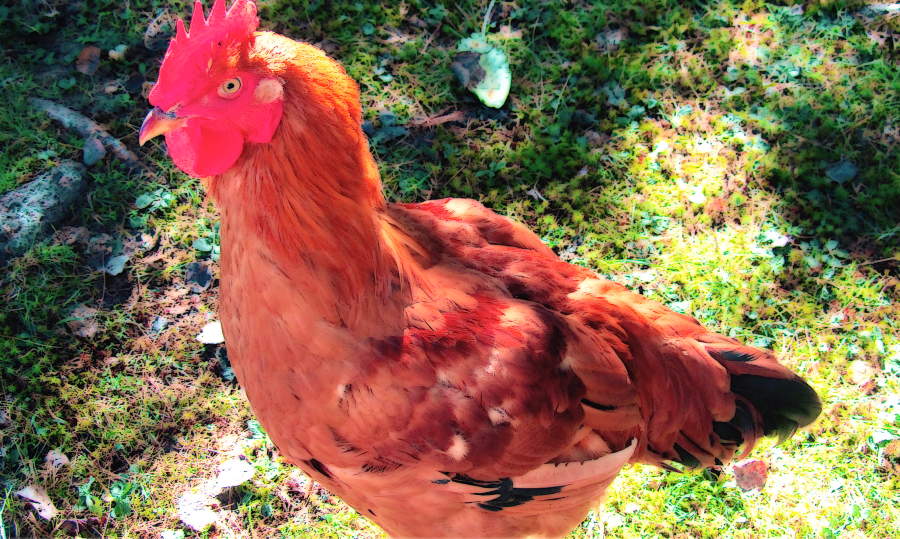
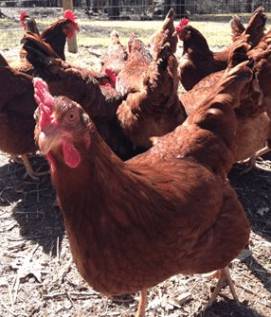
This is one of our curious girls. I was taking pictures of the chickens at snack time, but this little girl seemed way more interested in my camera.
Some are mama’s girls, some are daddy’s girls, and some are just their own girls. Some are scared of a new bowl, the baby ducks, and maybe their shadows. Some are way too bold, in my opinion.
Right now, we have a broody hen, who is so grumpy when we take her eggs, but we have to because we have no rooster yet. So my husband takes her grapes in the evenings, her favorite treats, and he talks to her while he reaches in and takes the eggs. She calms down when he talks to her. She lets him rub her little beak and head, and she talks back. I watch this in awe—two species, unable to communicate with each other, but the chickie girl seems to somehow understand my husband means her no harm. It’s a powerful sight to see.
It was a tough week for the Sands “Coop”eration with the loss of one of our girls, but I hope that telling her story can help just one more person decide not to buy eggs from a factory farm anymore.
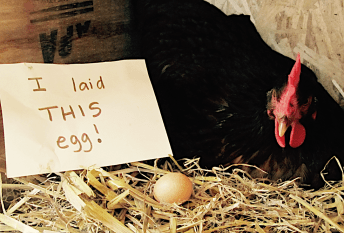
You may have seen the images of the chicken shaming that have been going around social media in the past few weeks, and I hope they made you smile as much as they made me smile. The one about the chicken who ate the mouse whole really made me giggle. I haven’t seen my girls do anything like that, but I have seen them take down some pretty large and pretty gross things, mainly fat grubs.
The images got me to thinking about my own girls’ behavior and how hilarious our chickens are. They make me laugh all the time, though they can also be a real pain sometimes, and those chicken shaming images made me want to share with the world how wonderful, awful, funny, and wild our chickie girls are.
Now, let me tell you, shaming your chickens is not as easy as it seems. I don’t know about other people’s chickens, but my girls are pretty tame. Yet the first time I tried to hang a sign on one’s neck, I felt like the worst chicken mama in the world! My poor sweet girl was so scared and seemed convinced the sign was going to be the death of her. Needless to say, this broke my heart and made me realize that I was going to have to find an easier way to shame my chickens and share their cuteness with the world.
I could only manage a few, as word spread quickly amongst the girls that mama was up to no good, so I could only put the signs I made near the “guilty” chickens in question. It worked pretty well overall, but I have many more stories to tell, like how the chickens have completely dug up our yard or how they moan and groan and squawk and cry to the high heavens until they are let out to free range each day.
But I’ve captured some of what it’s like to live with chickens, I think. I love these stinkers!
I don’t even know how this happens, but, a couple of times, one of the girls will lay a mini egg. It’s adorable but not worth much. There’s no yolk–at least there wasn’t a yolk in the first one we found. But, of course, I’m fine with a tiny egg every now and then. It’s just too funny that this happens.
This next one is Guineveve, and she’s one of our newer babies. She’s an ISA Brown, and we found out that this breed originated in France. Unlike our 17 Rhode Island Reds, each of the ISA Browns looks a little differently than the next one, so we’ve been able to name these girls.
Guinevieve is the most beautiful to me, but she’s also the most aloof. She lets us pet her, but she doesn’t come running to us like the other girls. And, most worrisome, she doesn’t seem to like hanging out with her sisters very much. She even roosts by herself at night.
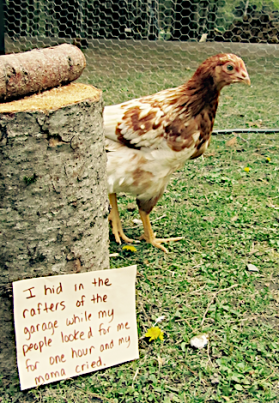
Well, this week, we thought we’d lost her, our first loss. If you read my original post on counting chickens, you know how much I worry about losing one of our girls. Guinevieve seemed to be our first casualty this week.
It was time to put the little girls up for the night, and my husband said he could only find 7 of 8 baby girls. The girls are sleeping in the garage right now, so I was sure our chicken was somewhere in there. But, when I went outside and looked at the baby girls, I realized the missing girl was Guineveve! Considering her loner behavior, I thought maybe she was really gone.
I thought surely she had flown out of the open garage door and had been chased into the woods by one of the bigger chickens, only to be eaten by a fox, hawk, bobcat, or some monstrous, chicken-eating creature in our woods. It was getting late, and we looked for an hour with flashlights, calling for her. I was crying, and my husband seemed to feel so badly. I was trying so hard to tell myself that I had to deal with this kind of thing, that this kind of thing has happened to our neighbors times 10, times 20! I had to be tough.
I kept going back and looking in the garage, just to be safe, but still, just 7 of 8 little girls. But, then, after a little more hunting, my husband said, “I wonder if she’s still in the garage somehow,” and it dawned on me–I had not looked up really high. I just assumed she could not get up to the rafters in our garage.
Guess what! That’s where she was! When I opened the garage door, looked up, and saw her little white tail feathers, I was happy, relieved, and bemused that this little stinker had caused such a commotion. So we still have Guinevieve, but she’s getting shamed this week!
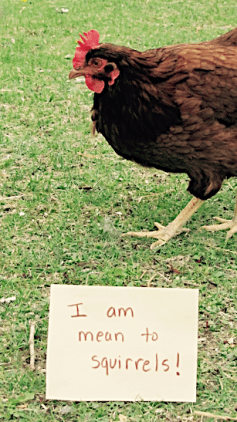
And, though I love our chickie girls more than I can say, I have to admit that the girls can often be stinkers–even a little mean. I have to stay on them and “be the rooster” sometimes, but, when they can, some of them will be little bullies. This spring, several of them have taken to bullying the poor little squirrels in order to take the seeds from the squirrels we feed. Or, perhaps, they do it out of spite because I see how enviously the chickens look at the squirrels when the squirrels are running free in the mornings while the chickens are still waiting to get out of their pen. I’m pretty sure those squirrels are getting the evil chicken eye.
So, this week, my mean girls get shamed as well!
Finally, after spending this morning “chicken shaming” and scaring some of my girls half to death with my little signs, my husband said that I should be shamed myself. I think he’s right. Our little chickie girls are sweet and beautiful and, sometimes, downright ornery, but I never want to make them feel badly. So my final sign is for me.
And, since I wasn’t able to tell all of my girls’ ornery stories via pictures, I’ll just have to tell more stories in the weeks to come. If there’s one thing I’ve learned from raising chickens, it’s that those girls are always up to something and always completely entertaining!
“If it’s possible to ruin a chicken in such a way, I’m sure you’ll do it.”
These are the words my husband spoke to me after I told him a story in which I was worried I was maybe spoiling our chickens a little too much.
Here’s what has happened of late:
Each morning, before I collect eggs, the chicky girls get a bagel, and it can be tricky to get 17 chickens to be “fair” when it comes to bites of bagel. I developed a system where I throw exactly 12 pieces into the middle of the chicken run, and while about 10 or 12 girls head to eat those, a handful hangout with me, knowing I will drop some at my feet for them. This plan has been working well for almost a year.
But I think the “spoiledness” reached new heights a couple of weeks ago. The girls who hang out at my feet for bagel bites will squawk at me until they get a bite of bagel, and I noticed that a couple of girls just kept squawking and looking at me hopefully, even though I had dropped bites of bagel on the ground right in front of them.
It looked like they wanted me to feed them directly, so I tried that. Guess what? It’s what they wanted!
But, then, because chickens are copy cats, like 3 or 4 other girls wanted the same treatment, so I was trying to get bites of bagels into beaks as quickly as I could and trying not to get my fingers pinched.
Thankfully, after about a week of this routine, the girls are now really good at aiming for bagel only and not my fingers, and it’s pretty adorable to see these girls jumping up like little chicken basketball players to get their bites out of my fingers. But, the sad reality is that I think our girls might be too spoiled.
This morning, I think things reached a new level. Today, I had about 6 or 7 little chicky girls, in a line, jumping up one at a time to get her bagel bite. The girls took turns, jumped up like little basketball-playing chickens, flapped their wings once for each jump, and looked so adorable I almost couldn’t believe it.
I have no idea how this just happened, but if I can get this to happen again (tomorrow, I am going to try to get my husband to film this), I have decided that I might need to take this show on the road—“Crystal and Her Amazingly Spoiled Chickens.”
These were our girls in the coop this morning in the morning light after our little circus performance. They are so beautiful I don’t know how to not spoil them.
Still, my husband’s comment about how I will find a way to spoil animals as well as my experiences this week really got me to thinking about how this is happening. I mean, it would be much easier for me if these girls would just eat their bagel bites off of the ground. Is it okay that these girls are this spoiled?
So I spent a couple of weeks mulling this over, and after much thought about my thinking, I realized what might be at the root of my track record with spoiled animals.
If an animal is smart enough to communicate with me, an animal of a completely different species, its wants and needs, I feel it is important to reward such intelligence and skills. And, since science is proving all the time that animals are way smarter than people thought, smarter than I thought, I find myself with a lot of spoiled animals.
I will continue my reading on animal intelligence and maybe have to rethink my philosophy about how I approach our animals and their level of intelligence. I don’t think I have been giving them enough credit, and I had better do something. We have 8 more little girls growing up right now, and if I have to feed 25 chicky girls grapes and bagels individually, that’s going to be a job!
But I have to say that my husband is not a complete innocent here. One night this week, I caught him out in the garage with the baby girls. He was whistling a sweet tune to them and giving them the meal worms he bought from the pet store with each little baby jumping up to take a worm from his fingers. Indeed!
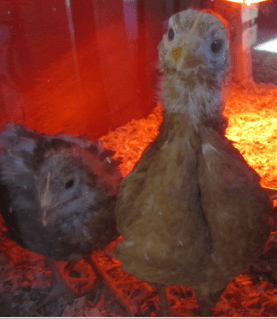
This is one of the baby girls now. I call this the “awkward teenage weeks” when they have some feathers but some baby fluff as well. Still, they are cute beyond all reason, right? And, it’s really soon to tell for sure, but I think they may even be smarter than our first babies. These girls are ISA Browns–a cross between Rhode Island Reds, which we have already, and Rhode Island Whites.
It’s all coming together for me. I might know the root of the “feed me individual bites” thing. It’s not going to be easy not spoiling those chickens. Maybe I just need to be okay with spoiling them.
One, two, three, four, five…fourteen, fifteen, sixteen…Wait! OK. One, two, three, four, five…fourteen, fifteen, sixteen. I’m missing one chicken!
This is the story of my life. I have to hunt down “one more” chicky girl at least two or three times a day.
When we ordered our chickens, we wanted a dozen but ordered fifteen in case some didn’t survive the shipping. About two days after we got our chickens, my husband announced that we had seventeen, not fifteen. It seems the company sent us extra in case some didn’t survive. We’ve been counting to seventeen ever since.
Counting chickens has become such a regular part of my day and my husband’s day that all we have to do is shout to each other, “I got seventeen,” and we know what we mean, and we can relax—for at least the next little bit.
Our girls have a beautiful coop my husband built and a “run” that is surrounded by a very tall fence for chicky-girl protection, but our girls, our Rhode Island Reds, have strong spirits, free spirits, and they want to free range as much a possible.
Our girls love to free range and scratch around near the woods. I have to herd them out of the woods all the time!
Since we live right in the middle of some Maine woods, this means I live in constant fear of hawks, eagles, foxes, and weasels, and mysterious forest creatures of my imagination, all of which have a taste for chicken. If you know me, you know I’m a worrier. So I worry about our girls.
But, to be fair to myself, though I love my neighbors, they don’t help my worrying. I can’t tell you how many times I have heard that it’s “just a matter of time” before we “lose a few.” And one of our neighbors even told me a story—twice—about some kind of creature that killed most of his chickens and left their heads in a pile!
All I could do was make my “tragic” face and say “oh dear!” I mean, what kind of serial chicken killer lives in these woods?
So you can see why I worry—and why we count. On an average day, I’m not sure how many times my husband counts the chickens, but I’ll bet I head outside and count about ten times a day. And this takes some time. They’re never together and can be in all kinds of places on our property. They’re also extremely wiggly. It’s a job.
I used to be able to bribe the girls. I could bring out a small piece of bagel or fruit, call for my girls, and they would all come running. Now, I get like twelve when I do that. The other five make me hunt them down and worry.
The worst counting incident came in the late fall. It was early morning, and the girls were out in an open area to be in the sun. I was in the kitchen making breakfast when our youngest came running in to say he heard “a commotion” with the chickens. My husband and I ran outside just in time to see what looked like an eagle flying away. I didn’t know how long the “commotion” had been going on, but my heart sank. I figured it was “the matter of time” our neighbors had been telling us about.
Some of the girls were hiding in the garage, and they were very upset. We had thirteen in the garage, and some were so scared they were hiding within my husband’s tools on his shelves.
When I found three more girls hidden very deeply in some shrubs near the eagle sighting, I knew we had sixteen, and I was just sure that was it, that we finally lost one. My husband and I continued to search everywhere to no avail, and I began to cry. After a pretty exhaustive search, I headed back to the shrubs where I had found the other three, thinking that since I had not seen those girls originally, maybe I had missed one more. But nothing. No more girls.
As I walked back toward the house with a heavy heart, I can’t even begin to describe the beautiful thing I saw. My husband was coming from the backside of the house, and he was carrying number seventeen. I couldn’t believe it!
Sometimes, I think my husband is a super hero. He is a saver of days for sure. But this was big for me. He was the saver of chickens as far I was concerned. Now, I don’t mean to make it seem like my husband is always a super hero. I mean, he does leave the coffee grounds on the black granite in the kitchen most mornings, but, well, mostly he is a super hero. He just is. He was totally a super hero to me anyway as he carried that shivering chicky girl toward me.
He said he found her way down under the back steps of our deck. I don’t want to jinx us, but our girls are pretty smart. They seem to be good hiders.
Since that day, we make sure our girls have lots of places to “duck and cover,” and they do a pretty good job. Still, there is a lot of counting work to do each day.
Interestingly, even though the new babies we got last week are all contained in a temporary brood in my husband’s office, we find ourselves counting them too. One, two, three, four, five, six, seven, eight. They’re always all there—at least for now.
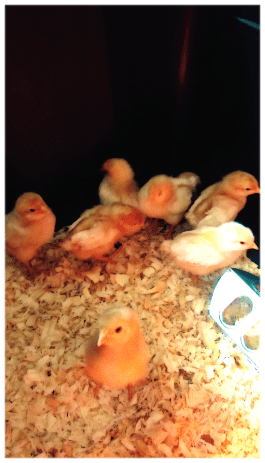
We have had our baby girls for about a week now, and they are starting to get feathers–and curious.
And, in the evenings, after the big girls have put themselves to bed, when I go out to close up their coop (and let me tell you it is like the Fort Knox of chicken coops), I do one more count—all the way to seventeen.
And I say goodnight to the girls, and they make their sweet, sleepy chicken noises (they coo). In my mind, as crazy as it sounds, I’m sure they’re saying goodnight and thanking us for worrying about them.












 Pajamas, Books, and Chickens