On Strawberry Scones

scone ingredients

It’s strawberry season here in Maine, and strawberries are my favorite fruit. Of course, during blueberry season, I’m convinced blueberries are my favorite fruit, but strawberries and I go way back.

When I was little, I loved strawberries with a passion, but, when I was growing up, we didn’t have a lot of money for things like fresh fruits, which meant I didn’t get a lot of strawberries. Still, every year, on my birthday in May, I would get a strawberry cake, and I would be in heaven.

I think strawberries became even better in my little child mind, and I’m pretty sure I built up a myth about how delicious they taste, though they’re pretty delicious. Still, I admired their color, texture, and juiciness to an unusual level, I’m sure. When I would see other children eating strawberries, I was undoubtedly too envious.

So, as an adult, when my husband and I started our garden, some of the first things we planted were strawberries. My husband built me two large raised beds, and we filled them up with June-bearing strawberries. Having to wait the first year, because you can’t let the plants make berries the first year they are planted, just about killed me.

But, now, we are all set, and as I fill up my bowl with the strawberries I pick in the mornings, I feel a little bit like my life has come full circle. I have plenty of strawberries, and I love that we grow them ourselves.

fresh strawberries
These strawberries were picked fresh for scones this morning. The harvests are still a little small, but the berries are really just getting going.

I even have enough to share, though I have found myself far less generous with our strawberries than I am with the other foods we grow in our garden. I may need to work on that, but, then, strawberries and I do go way back.

Anyway, since the glorious strawberries are upon us, I wanted to share the best strawberry scone recipe I have found. I have searched for nearly a decade for the best scone recipe, and I finally found one that, with some adaptation, worked very well, I think.

This recipe has been revised quite a bit but adapted from the beautiful cooking blog Pinch of Yum.

Makes 8 Giant Scones

Ingredients:

2 cups flour

½ cup sugar

1 Tablespoon baking powder

½ teaspoon salt

½ cup cold salted butter, cut into tiny cubes

1 egg

¾ cup heavy cream

1 to 1 ½ cups fresh strawberries, cut into small pieces

additional heavy cream for brushing before baking

1 ½ cups powdered sugar

3 Tablespoons milk

parchment paper

Directions:

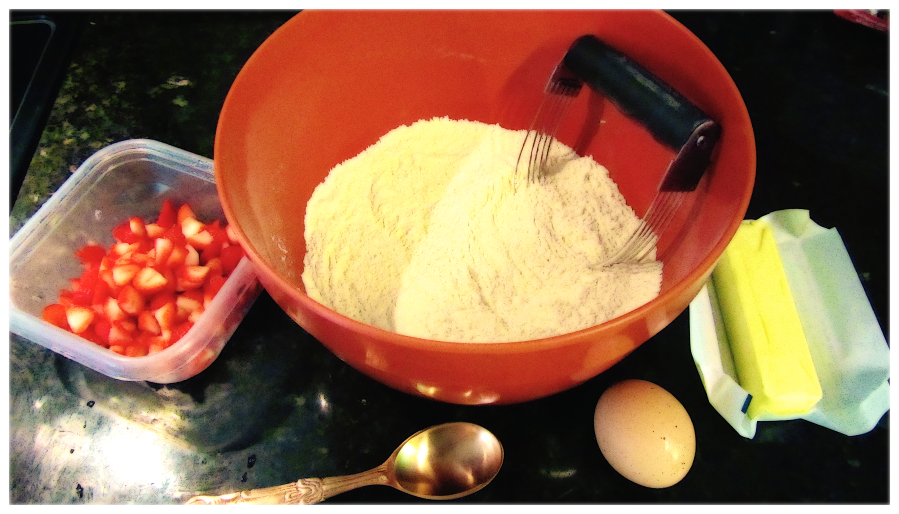
In a large bowl, mix together your dry ingredients. Then, add the tiny pieces of butter and cut the butter in using a cutting-in tool (I don’t know if those things have a particular name, but I have one pictured here). Then, mix in the egg and the heavy cream with a wooden spoon.
scone ingredients
Here are some of the key ingredients. I have no idea what the cutting in tool is really called, but it is a must-have for baking with butter.

Once things start to get a little bit mixed, you will likely have to use your hands. The dough is dense, and I usually have to work everything in with my hands to get things mixed.

Now, it’s time to add your strawberries. Using your hands, mix in the strawberries as much as you can without squishing them too much, though some squishing seems to be inevitable.

Bring the ball of dough to your counter covered in flour. Using flour on your hands to help keep the dough from sticking to you, spread the dough out into a relatively flat circle, as you can see in the picture.

Cut the dough into 8 triangles and place them on a cookie sheet lined with parchment paper. Now, brush on some additional heavy cream to make sure the tops of each scone are covered with the cream.

scones pre-baking
These are the scones pre-baking, cut from the flat circle into triangles. They will rise quite a bit, so that’s something to keep in mind.

Bake at 385 degrees for 16 to 18 minutes, depending upon your oven. I highly recommend you start checking at like 15 minutes because you never know.

When the scones are golden brown in the edges and can pass the toothpick test, they are done. Try not to overcook them.

While they are cooling, mix the powdered sugar and 3 Tablespoons of milk to make the glaze. The glaze should be pretty thick. If it’s too thin, it will just be absorbed by the scones, which is not as good, in my opinion. Brush the glaze on each scone after the scones have had a chance to cool just a bit. It’s okay if they are warm, just not hot.

Serve warm if you can, and enjoy!

strawberry scone
These strawberry scones are heavenly! I promise!

These strawberry scones were made with fresh strawberries from our garden, but if you don’t have strawberries growing in your back yard, check out this excellent blog post from Catching Health with Diane Atwood for places in Maine where you can pick fresh strawberries right now.

If you don’t live in Maine, come visit us at least. We have the best berries. I might be willing to share some.

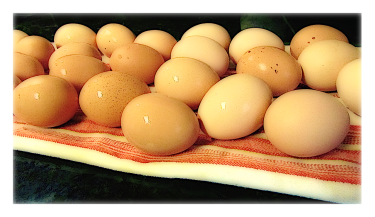
On Counting to 16 (and Some Tips on Buying Eggs)

image of eggs

Since my blog last Friday, we lost one of our chickie girls. If you’ve been following my blog since the beginning, you’ll know this was tough to take. If you read my On Counting Your Chickens post, you’ll know how much I worried about losing a girl.

Chickie Girl #17 didn’t have a name because we can’t tell our Rhode Island Reds apart, and now that she’s gone, it seems even more tragic that she didn’t have a name. But she was loved as a part of my collective “girls” and loved with all of my heart. We do so much to protect our girls from predators and work so hard to give them a healthy, happy life that it was especially hard for me to take it that we lost her to a health problem she had related to laying eggs. She had a prolapsed vent, and, apparently, not all chickens die from this, but our girl did.

It was a sad night.

I was cooking a late supper, and my husband came to the kitchen door and said, “I think tonight might be the night.”

It was the night I had dreaded—and the night we spoke about so often. Our girls free range most days, and they just can’t stand it otherwise. And even though we do a “chicken count” many times a day, we will sometimes get busy and not count as much. So, when the girls come into their coop at night, it’s always an extra relief when you do your final count for the night and get 17. But, this night, there would be just 16.

I cried harder than probably a grown woman should, said goodbye to her as she lay in my husband’s arm, and watched as my husband buried her in the backyard near the woods, where the beloved pets of the previous owners of our house were laid to rest.

I wasn’t going to write about this experience. It seemed wrong, like I was exploiting her death. I also worried about sounding a little too much like the crazy chicken lady because I was so broken up over the death of one of our chickens. But something happened this week that made me think I really need to tell this story.

As I was mourning the death of Chickie Girl #17, I took a moment to mourn the bigger picture—the animals who are unfortunate enough to live on factory farms where they are abused and subjected to the most inhumane treatment. Our girl’s death reminded me to remember.

Then, this week, this story hit our local news about an egg factory farm here in Maine where the chickens are, apparently, living in deplorable conditions. According to the news, the state is now investigating, but, for me, this story is just another example, another reason why we, as consumers, need to force change with our pocketbooks.

I don’t want to be preachy, but factory farming in our country is awful for the animals and awful for us. I certainly won’t get on my soapbox about the conditions in factory farms for all animals, but I will do this: I want to share some options with my readers about getting eggs and share why I think these options are important. My goal is to be helpful and help spread the word about better alternatives to factory-farmed eggs.

First, if you can, it’s certainly best to buy eggs from a local farmer you know. Just driving to a friend’s house a few miles away on Route 9 yesterday, I saw several signs up from local farmers selling eggs. If you can see where the chickens live, that’s even better.

image of eggs
We have Rhode Island Reds, so all of our eggs are brown. But there is such variety in terms of shade, speckles, and shape. These are like little treasures to me, and we sell them to friends and neighbors, who also seem to appreciate these eggs.

It’s important that chickens are allowed to be chickens. They need to be able to spread out, be social, eat bugs, complain about the little things, like somebody else being in one certain nest box when five others are clearly available. If you live in Maine and are reading this blog, I’m guessing you probably even have a friend selling eggs. It seems like chickens are everywhere here. Take advantage of this.

If you don’t live in Maine, I want to share some links that might be helpful.

  • EatWild offers an interactive map to local farmers who raise grass-fed animals. The site does not guaranty each farm, but each farmer has signed a statement about the way their animals are raised in order to be listed with this organization.
  • Agrilicious.org is a site devoted to connecting people with local farmers. Local farmers and artisans can sign up to share information about their goods, and you, as a consumer, can get connected.
  • Of course, be sure to check out your local farmer’s markets. In addition to getting connected to local food and handmade goods, they are just fun. This site, from the USDA, lets you search for local farmer’s markets by your zip code.

If you’re busy and feel you don’t have time to buy local, then it’s important to be aware of what the labels mean on the egg cartons at the grocery story. “Cage Free” is not necessarily good, and most of the labels like “All Natural” don’t mean a thing at all. You want to look for “Certified Humane” and/or “Pasture Raised.” I found this great article from NPR that provides interpretations for all of those labels on your egg cartons. It’s a huge help.

Having chickens of my own has taught me just how unique and important each little life is. I still eat meat, but we are working very hard to only buy our meat from places where the animals are allowed to be animals and live a good life while they live—or raise the animals ourselves.

Our little chickie girls are funny, interesting, and each one is unique.

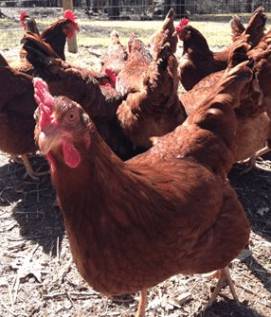
curious chicken
This is one of our curious girls. I was taking pictures of the chickens at snack time, but this little girl seemed way more interested in my camera.

Some are mama’s girls, some are daddy’s girls, and some are just their own girls. Some are scared of a new bowl, the baby ducks, and maybe their shadows. Some are way too bold, in my opinion.

Right now, we have a broody hen, who is so grumpy when we take her eggs, but we have to because we have no rooster yet. So my husband takes her grapes in the evenings, her favorite treats, and he talks to her while he reaches in and takes the eggs. She calms down when he talks to her. She lets him rub her little beak and head, and she talks back. I watch this in awe—two species, unable to communicate with each other, but the chickie girl seems to somehow understand my husband means her no harm. It’s a powerful sight to see.

It was a tough week for the Sands “Coop”eration with the loss of one of our girls, but I hope that telling her story can help just one more person decide not to buy eggs from a factory farm anymore.

On Making Good Dreams (with Help from Quilts)

Quilt Fabric

This one is about making quilts–well, mostly.

In my grand designs to become more self-sufficient or at least a really good maker, I have many skills I need and want desperately to learn—knitting, canning, making jams, and maybe making wood furniture, but I don’t know how realistic that last one is since I’m terrified of even the smallest power tool. It’s like a phobia or something. I hear a power tool, and my heart just races. I worry about my husband all the time.

But I digress…

One of the things I can make is a quilt. Now, I’m not the greatest, though I used to be pretty good, but I can make some decent quilts—at least I can very slowly. Recently, I was actually very slowly working on a quilt for a friend, when I had a quilt emergency: We decided it was time for our youngest to sleep in his own bed. He’s six years old and a pretty big boy, so my husband and I, even in our king-sized bed, were running out of sleeping space.

Now, if you’re one of those people who is going to say “What in the world are you doing letting your kid sleep with you?” let me just say that you can save your breath or text trying to change my mind on this point. We researched it thoroughly, and my husband and I made a conscious decision to let our son start co-sleeping with us when he was little.

We read all the advice from every major theorist and child psychologist out there and settled on this point—we wanted to get some sleep. Also, we believe in the health and bonding benefits of co-sleeping—but mainly we wanted to get some sleep. But, if you’re a new parent and interested in some of the research on the benefits of a family bed, please message me.

Anyway, a few weeks ago, our youngest made the big move to his own room and his own bed. The first night was hard for me, and I cried a lot. But, by the second night, I was like “Oh, this space is lovely.” “Oh, it’s nice not to be kicked in the back.” And, “oh, I love getting to keep the covers on me.”

However, much like his mama, our youngest is afraid of the dark and has a vivid imagination, so I have decided to make him a “good dream” quilt to keep him safe. It will be complete with a shied of love from mama on it. This is definitely a quilt emergency, right?

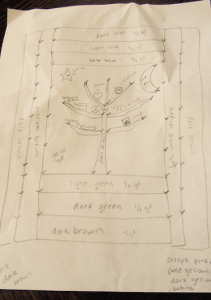
This is a picture of the plans I sketched out under my son’s direction. It’s all wrinkly from carrying it around at the fabric store.

Quilt Plans
This is my sketch based on my son’s directions. I have poor drawing skills, but, hopefully, this quilt will turn out well.

So, inside the dream tree in the middle, I told my youngest we could put all the things that make him feel happy and safe. Here’s what he chose:

  1. a Pi symbol
  2. a basketball
  3. a present with a red bow
  4. a pink heart that represents mom and dad’s “love shield” as he calls it
  5. a Pac Man
  6. a Minecraft block
  7. and a green canoe (something our family has wanted for a long time)

It all sounds great, right? I’m so excited just writing about it.

The problem is I barely have time to work on it. In all of my efforts to simplify, I still struggle to get everything done at the end of the day, and I am even, realistically, always a little behind. I still work at least a half day every day, and that includes weekends, and with homeschooling, cooking, planting the giant vegetable garden, and helping to care for the animals, I run out of time at the end of every day. Of course, right now things seem to be worse because the animals are little and the garden planting is a slow, tough process when you’re tilling with a shovel, and there’s just no way to plant carrots quickly. Those seeds are a tiny nightmare!

So I’m determined to make the time. It turns out that, in my efforts to be more of a maker, one of the things I’m going to have to learn how to make is time. Quitting my full-time job helped, but I’m still partially immersed in the academic world, and sometimes, the push and pull between that world and our little hobby farm leaves me with so little time at the end of the day.

But this quilt is important to me because I think it will be important to my little boy. When my oldest son was little, there was one Christmas (my first year of teaching full-time) that I couldn’t afford Christmas presents for him. I made him a star and moon quilt, and he still has it—and seems to really care about it. For his high school graduation, I made him a second quilt because, of course, high school graduations are important. He sleeps under it every night.

Now, it’s my youngest son’s turn. This dream quilt is important, and I am determined to make this quilt for him. It feels representative of my efforts to simplify, make, and find out what’s important. It’s not easy, but it’s what I want. I have my fabric selected. This weekend, I will get this going.

Quilt Fabric
I love these colors. I think this is going to be beautiful!

I think the lesson here is that it’s going to be hard for all of us to find balance in our lives. We all have so much going on with work and family and about a million other things we must balance. But I’ve learned that you have to set your goals about what’s important to you and then just take the time—or make the time—if you want to be a maker like I do and still have time to enjoy yourself and your family along the way. Life’s just going to pass us by otherwise, I think.

I’ll keep you posted on the quilt…

On Learning Truths

early garden

This year’s going to be the fourth summer my husband and I do a big vegetable garden together. Right now, we have only the peas, carrots, potatoes, and onions in the ground, but in Maine, this is to be expected. It was pretty chilly until last week. Sometimes, I forget that growing up in Texas we were wearing shorts by May.

I’ve seen friends from other parts of the country post pictures on social media of food they’ve already grown in their gardens, and I feel confused at first because we just started planting. It’s almost surreal for me to see a fully-grown vegetable in May.

But I digress…

This post is supposed to be about my green thumb I thought I had.

The story goes like this.

Every year, even our first year of vegetable gardening, though we had some failures for sure, my husband I have had some pretty good successes growing food. We always have a good harvest, at least to me, and last year, we grew so much food that we were really able to see a cost savings on our grocery bills from late summer until early winter. That’s pretty good, right?

I post pictures to Facebook of our beautiful garden starting in early summer. The peas are ready to eat; the bean bushes look big and lush; the carrot and potato plants look big and healthy. I’m always so proud of this garden.

I do help my husband a lot. He definitely does the lion’s share of the work–tills by hand, gets the soil ready, fertilizes, waters, hoes weeds. Wait, why do I think I help a lot?

Well, I do plant, pull weeds, pick bugs off one at a time for hours on end, and help harvest. But as I write this down, I am realizing a deeper lesson I learned this week. I think my husband really is making all this good food happen. I thought I was helping more.

He has always had a green thumb and this love of plants that I didn’t understand until we had a garden. He’s got some real skill at making plants grow healthy and strong, and I envy it. I’ve always been horrible at plants. I’ve killed everything from roses to sunflowers to a wide variety of houseplants. I don’t think I’ve ever grown more than a weed successfully, and if I had tried to grow said weed, I probably would have killed said weed.

But, then, there was this beautiful garden. I thought I was helping to grow it. I thought my husband had somehow lifted the “curse” I had with plants. I thought I was becoming a good gardener, too.

early garden

This is a picture of one of our first gardens when it was first getting going. It’s so lovely. And, in case you’re wondering, that’s a gnome guarding the peas. It totally works!
However, I recently learned some truths about my newly-found “green thumb.” I started some seedlings this year in the house—without my husband’s help in any way—and I found out that maybe I still have a long way to go in terms of gardening.

So, I’m guessing you can imagine that things didn’t go so well.

We always do well in our garden starting most of our plants from seed, but I wanted to try to get a few starters going this season of things we sometimes buy as plants from the local nursery–peppers, tomatoes, and such. Unfortunately, pretty much everything I started died!

I planted like 25 broccoli starters and about 20 tomato starters. Not a single one of them made it. I also planted several kinds of peppers, about 30 plants total. I have 6 plants that made it.

I’m not sure what happened. Mostly, between part-time work, homeschooling, and feeding both people and creatures three times a day, I would somehow forget to water the little plants every day. It would seem like I just watered them, and then, sadly, some would die. Apparently, I had not just watered them. <sigh>

But my greatest mistake came when I put the plants out in the sunlight to grow stronger during the day; on the fourth day, I forgot to bring the plants in at night. I lost every tomato plant that night! I woke up at like 4:00 in the morning that chilly, fateful night, realized what I had done, and went back to sleep with sadness and disappointment in my heart.

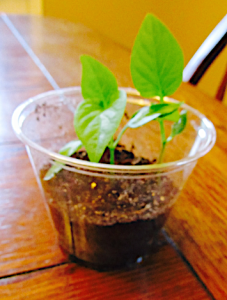
pepper plant
This is one of my 6 survivors. I have no idea what kind of pepper plant it is, and I don’t even care. I’m just so glad it’s still alive!

So, yeah, now I have 6 plants left, and I’m hanging onto them for dear life!

Ironically, this year, my husband is putting up a fence around our property, and, when I say he’s putting up a fence, I mean he’s digging hundreds of holes through rocky earth with a shovel and putting up a fence the old-fashioned way. It’s pretty epic!

So I’m working to get the garden planted while he puts up the fence. After my little experience with the starters, this is making me really nervous. But, so far, so good. I have battled the black flies and mosquitoes, tilled that garden with a shovel (one slow row at a time), and we have a few things in the ground. The peas look great. Nothing else has had time to grow, but it’s still early.

I’m optimistic, but it’s a cautious optimism. I’ve learned a hard lesson of late.

baby duck in pool
This baby duck loved the new pool, and I loved watching those babies play! I need to do a whole blog on those duckies. They are way more interesting that I imagined they would be.

We still have the kale, red beans, green beans, tomatoes, lettuce, and corn to plant, but, this afternoon, we took a break from the tilling and the sowing and the fence making and had a late lunch at Jimmie’s, bought a kiddie pool for the baby ducks, and watched them have a blast in the pool. I think my husband and I are both a bit worn out this week, as living the simple life can be a lot of hard word, so taking the afternoon off seemed to be the best medicine.

This weekend, however, is Memorial Day weekend, which is always the weekend we finish planting our garden. After discovering some truths about my gardening skills, I hope you’ll wish me luck. I’m going to need it!

I’ll keep you posted…

On Chicken Shaming

You may have seen the images of the chicken shaming that have been going around social media in the past few weeks, and I hope they made you smile as much as they made me smile. The one about the chicken who ate the mouse whole really made me giggle. I haven’t seen my girls do anything like that, but I have seen them take down some pretty large and pretty gross things, mainly fat grubs.

The images got me to thinking about my own girls’ behavior and how hilarious our chickens are. They make me laugh all the time, though they can also be a real pain sometimes, and those chicken shaming images made me want to share with the world how wonderful, awful, funny, and wild our chickie girls are.

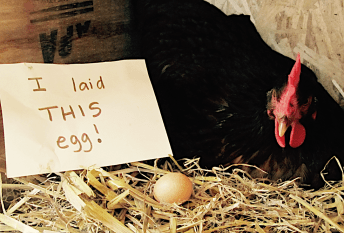
Now, let me tell you, shaming your chickens is not as easy as it seems. I don’t know about other people’s chickens, but my girls are pretty tame. Yet the first time I tried to hang a sign on one’s neck, I felt like the worst chicken mama in the world! My poor sweet girl was so scared and seemed convinced the sign was going to be the death of her. Needless to say, this broke my heart and made me realize that I was going to have to find an easier way to shame my chickens and share their cuteness with the world.

I could only manage a few, as word spread quickly amongst the girls that mama was up to no good, so I could only put the signs I made near the “guilty” chickens in question. It worked pretty well overall, but I have many more stories to tell, like how the chickens have completely dug up our yard or how they moan and groan and squawk and cry to the high heavens until they are let out to free range each day.

But I’ve captured some of what it’s like to live with chickens, I think. I love these stinkers!

chicken with small egg

I don’t even know how this happens, but, a couple of times, one of the girls will lay a mini egg. It’s adorable but not worth much. There’s no yolk–at least there wasn’t a yolk in the first one we found. But, of course, I’m fine with a tiny egg every now and then. It’s just too funny that this happens.

This next one is Guineveve, and she’s one of our newer babies. She’s an ISA Brown, and we found out that this breed originated in France. Unlike our 17 Rhode Island Reds, each of the ISA Browns looks a little differently than the next one, so we’ve been able to name these girls.

Guinevieve is the most beautiful to me, but she’s also the most aloof. She lets us pet her, but she doesn’t come running to us like the other girls. And, most worrisome, she doesn’t seem to like hanging out with her sisters very much. She even roosts by herself at night.

Well, this week, we thought we’d lost her, our first loss. If you read my original post on counting chickens, you know how much I worry about losing one of our girls. Guinevieve seemed to be our first casualty this week.

It was time to put the little girls up for the night, and my husband said he could only find 7 of 8 baby girls. The girls are sleeping in the garage right now, so I was sure our chicken was somewhere in there. But, when I went outside and looked at the baby girls, I realized the missing girl was Guineveve! Considering her loner behavior, I thought maybe she was really gone.

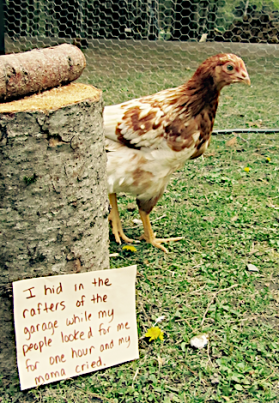
Hiding Chicken

I thought surely she had flown out of the open garage door and had been chased into the woods by one of the bigger chickens, only to be eaten by a fox, hawk, bobcat, or some monstrous, chicken-eating creature in our woods. It was getting late, and we looked for an hour with flashlights, calling for her. I was crying, and my husband seemed to feel so badly. I was trying so hard to tell myself that I had to deal with this kind of thing, that this kind of thing has happened to our neighbors times 10, times 20! I had to be tough.

I kept going back and looking in the garage, just to be safe, but still, just 7 of 8 little girls. But, then, after a little more hunting, my husband said, “I wonder if she’s still in the garage somehow,” and it dawned on me–I had not looked up really high. I just assumed she could not get up to the rafters in our garage.

Guess what! That’s where she was! When I opened the garage door, looked up, and saw her little white tail feathers, I was happy, relieved, and bemused that this little stinker had caused such a commotion. So we still have Guinevieve, but she’s getting shamed this week!

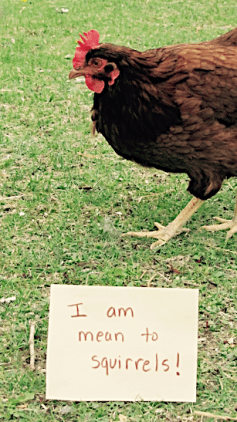
chickens with sign about squirrels

And, though I love our chickie girls more than I can say, I have to admit that the girls can often be stinkers–even a little mean. I have to stay on them and “be the rooster” sometimes, but, when they can, some of them will be little bullies. This spring, several of them have taken to bullying the poor little squirrels in order to take the seeds from the squirrels we feed. Or, perhaps, they do it out of spite because I see how enviously the chickens look at the squirrels when the squirrels are running free in the mornings while the chickens are still waiting to get out of their pen. I’m pretty sure those squirrels are getting the evil chicken eye.

So, this week, my mean girls get shamed as well!

Finally, after spending this morning “chicken shaming” and scaring some of my girls half to death with my little signs, my husband said that I should be shamed myself. I think he’s right. Our little chickie girls are sweet and beautiful and, sometimes, downright ornery, but I never want to make them feel badly. So my final sign is for me.

author shamed

And, since I wasn’t able to tell all of my girls’ ornery stories via pictures, I’ll just have to tell more stories in the weeks to come. If there’s one thing I’ve learned from raising chickens, it’s that those girls are always up to something and always completely entertaining!

On My Favorite Things About Living in Maine

If you’ve never been to rural, wooded Maine during black fly season, you can’t understand just how bad it is. When I first moved to Maine and people told me about “black flies,” I was like, “All flies are black.” But these are flies of a different sort.

They are small. They are mean. And they are legion.

Right now, as we work in our yard, garden, or take care of the animals, we are followed by a cloud of biting black flies. They go up your nose, down your throat, in your eyes, and I have to comb my hair several times a day to rid my long hair of the pesky little carcasses.

It’s been a tough week in the insect department here in Maine.

But my husband says that this is just what keeps the cost of real estate down in what, otherwise, has to be one of the most beautiful places on earth. So this week, to keep my Zen and remember why I love Maine so much, I am devoting my post to some of the things I love about living in Maine. Keep in mind, I am from “away,” which I will have to explain to some of my readers in another post at a later date.

1. Mainers dress for practical purposes.

I’ve never been one for wearing fancy clothing. In fact, there’s evidence of an epic battle my poor mother endured throughout my childhood in a picture of my first day of school when I was five years old. She put me in a pretty dress. It was itchy. I hated it. I let her know about it.

All of my life, I have preferred comfort over style, which was not the most popular approach to fashion when I lived in the Dallas area. And, since I’ve been working from home the last few years, my focus on comfort has become even more pronounced. I wear my pajamas and house slippers just as long as I can every day. In fact, I used to walk my oldest son to the bus stop on our road in my robe.

My sweet neighbor knitted me some mittens to match my robe for the chilly mornings at the bus stop. Yes, Maine is awesome like that.

But this is always how I know for sure I found my people. I sometimes have to travel for work and make presentations at conferences. It’s then that I become very much aware of my struggling fashion sense. I see suits, heels, manicured nails, and perfect lipstick at the conferences, in the restaurants, at the airports. I am out of sorts for sure.

But, when I am headed home and get on my last connecting flight to Bangor, I see LL Bean boots and bags, jeans and sweaters, and all kinds of reasonable-to-me clothing, I am thankful to be with my people again.

Bean Boots
These are my Bean Boots, and I love them. They are pretty hard to come by, as they are really popular. Apparently, Mainer style has spread to the rest of the country, but my son worked at the LL Bean call center last Christmas and helped me get on the list! These practical and comfortable boots are symbolic of Maine comfort to me.

2. Your neighbors will truly help you in times of need.

I’ve never seen anything like the neighborhood support I have seen in Maine. I think we might be particularly fortunate in the neighbor department, but I have heard others say the same things about how kind and helpful their neighbors here are.

I first realized this when, shortly after we moved here, I had to have surgery. On the second day after my surgery, our next-door neighbor arrived with enough stew for two dinners and a large batch of homemade rolls. It was touching and so kind and so needed.

But that was when we had first moved in and didn’t know many of our neighbors yet (we are a family of introverts). Last summer, my husband was injured in a chemical burn incident involving some super-caustic concrete. For real, it takes two of us to run this house and care for the boys and our animals. Having my husband injured so badly was both scary because I was worried about him and exhausting because it meant I had to run the house alone, but we would soon get help.

It wasn’t long before our dinners were arriving at the door, neighbors were pulling the weeds in our vegetable garden, and one neighbor helped my husband finish the critical chicken pen. It was like a little rally of support, and it touched my heart.

Still, these are just a couple of many stories of kindness and support we get from our neighbors. Even growing up in rural Texas in the 1980s, I didn’t see anything like this, and Texas is a really friendly place.

Writing about this kindness in Maine totally makes the black flies more tolerable.

I was recently having a conversation with a family member who was telling me that people just don’t care about each other enough anymore. I told him I had seen evidence to the contrary in Maine. I think he might want to move here.

3. The ocean.

There’s not too much I need to say about this one. We live about 40 minutes from the coast, and we can visit any time of year. The ocean speaks to me, as I know it must to so many others. We have a lot of ocean in Maine. The ocean is good for my soul and always a treat. I grew up in the middle of Texas and saw the ocean only a few times in my young life. Yeah, I’m thankful to live near the ocean.

Schoodic Point
This is Schoodic Point overlooking the Atlantic in Acadia National Park. It is breath taking!

4. Even though the winters are long and can be tough, they are beautiful.

My former department chair told me that you just have to find the beauty in the winter. It’s true, but it’s not hard for me. I do like the cold anyway. Every time I visit my home state of Texas in the summer, I am convinced I will die walking between the house and the car and the car and the house. So the cold is fine with me.

But the winters here are long, and, sometimes, especially in February, the negative temperatures feel brutal to this southern girl.

Yet the beauty of these long, brutal winters gets me through it. The snow on the pine trees. The ice on the rocks. The serenity of freshly-fallen snow. These experiences are amazing and wonderful to me. Maine is a beautiful place in the late summer and early fall, the most beautiful place on Earth, I am convinced. But the winters are spectacular to me as well, and even though they are long and tough, there’s something really empowering about coming through one.

Just don’t forget to take your Vitamin D.

yard in Maine in winter
This is a picture of winter in our front yard. Love!

5. Halloween.

Just wait until Halloween. I can’t wait to blog about Halloween in Maine. For now, I’ll just say this: Halloween is my favorite holiday, and Mainers “do it up” right!

When I first moved to Maine, I lived in Bangor, and I couldn’t believe the decorations, the costumes, and even the fortune teller at one person’s house. Now, even though we live in the country, I am impressed with the way Halloween is handled. The treats are big, meaningful, and full of love. Even though our oldest son is 19, some of our neighbors still make up treats to send home for him with our youngest, who is way into trick-or-treating.

I love Halloween in Maine. It’s like the Halloween I imagined from my childhood, and I am thankful to live here.

Just writing about all of these lovely things about living in Maine is helping me get my Maine Zen back. Of course, it helps that I am inside writing. My poor husband is outside working in the garden getting eaten alive I’m sure. But we’ll get through this, and, as soon as this is posted, I will go outside to help my husband. I will not be defeated by those flies!

Even though I’m from “away” and can never be a real Mainer, I’ve learned to be tougher from living in Maine. I’m still a little wimpy though, so I’ll probably be complaining about the black flies all the way to Father’s Day. I’ll try to keep it to a minimum though.

On Making Friends

I’m an introvert in a pretty extreme way, and the older I get, the worse it seems to get. I mean, I can function when I have to, and for nearly twenty years, I stood in front of a classroom as a teacher. But it’s hard.

And, as an introvert, I always find it interesting that I both love people and feel drained by being around people. From my perspective, it’s definitely a myth that introverts don’t want to be around people. I’m so interested in people and love to hear their stories, but I get so nervous on the inside when I am around people that I end up being worn out from trying to pretend like I’m “normal.”

Interestingly, there are some people who can, somehow, actually add to my energy levels when I am around them—people who are warm, safe, and highly interesting to me. I wonder if they know who they are, if they know how wonderful they are to me. And, since I am not drained from being around them, I always wonder if I am draining them.

Anyway, since human-to-human friendships have been difficult for me, I have always been a good friend to animals. I remember loving animals a little more than the average kid when I was younger, but I was mainly just a dog person. As I have grown older, I have found great joy in just hanging out with animals and a greater variety of animals. It started with our first cat we adopted.

I’m allergic to cats, so I have never been around them too much, though I have always had a great admiration of them and always wanted one. When we moved to Maine and I learned that Maine Coon Cats are a little easier on people with allergies, I knew this was my solution to my conundrum. Then, I found out how much Maine Coon Cats cost, and I realized I had not really found my solution.

So, we just decided to find a cat that had some Maine Coon “leanings” and hope for the best. I was willing to take allergy meds if necessary. I really wanted a kitty.

One day, pretty much out of the blue, my husband said, “Let’s go see what they have at the Humane Society in the way of cats.” I was surprised but ready—and nervous. I didn’t know how to be around cats at all. My general impression of them was that they were more aloof than dogs and could be grumpy and less forgiving. That, plus my allergies, made me a little nervous, but I didn’t want to admit this to my husband. I had been considering a kitty for a long time. I thought this might be my chance.

When we arrived at the Humane Society in Bangor, Maine that day in February, they had one cat available for adoption. One cat! The rest were not ready for homes yet. I was like, “Well, let’s see this kitty!”

In the cage sat a beautiful but skinny kitty who definitely had some Maine Coon leanings, at least I thought—big feet, tufts on her ears and feet, and she was super soft. I decided to give her a test: I would give her a pet, and if she responded well, I figured she passed the test. I reached in to pet her, and she leaned in so hard to my petting that she fell off of the ledge she had been on. This was my cat! Love with gusto, even if it hurts sometimes!

Sophie the Cat
This is Sophie, who taught me that I’m an animal person–not just a dog person.

In the days after we brought her home, my allergies flared horribly, so I had to go on allergy meds. And, sadly, our beautiful kitty I named Sophie seemed terrified in our house. She hid in the basement a lot. But we hung in there, and we found that Sophie and I have one key thing in common—we love, love, love soft fuzzy things.

Enter my robe. Since it was February, I was wearing my robe around every morning and every evening. It’s a thick, soft, fleecy robe, and I soon realized that Sophie loved it. She would stay in my lap when I had on the robe. And, soon, she was kneading on my tummy and purring. It was a process, but Sophie and I fell in love with each other.

In the last year, I have also learned how to be friends with my chickens. I like to hang out with them and watch them do what they do. They are always busy and have so much personality. Now, I don’t want to give a false impression: We have 17 chickens, plus 8 baby chickens. Not all of them are sweet little birds. Some really are. Some are pretty ornery.

There’s one girl, the smallest of our original 17, who escapes the run, even when it’s not time for free range, runs around like mad, won’t let me pick her up in my arms like many of the others, and generally just drives me crazy. One time, I yelled at her that she was going to the chicken stew first, but then I felt really badly and decided this would not be true.

If you have been following my posts, you know that I hang out with animals a lot, maybe too much. I have found that even just watching the squirrels and birds at the feeders brings me great satisfaction. I’m convinced I have made friends with one of the red squirels in our yard. I still love people, but animals are way easier for me to hang out with. There’s no judgment, real or imaginary. At least I don’t think so.

And, hopefully, my kitties and my chickens are good with being my friends as well. Of course, I don’t know what’s going to happen when my chicky girls quit laying eggs. I’m not sure how I’m going to separate friendship from farming. I have been reading about it and trying to prepare myself. I think I can do it when it’s time, but I’m not sure.

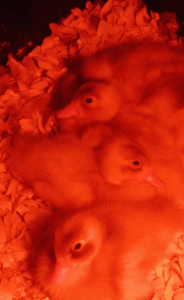
baby ducks
This week we welcomed 6 baby ducks–Indian Runner ducks–to help eat the bugs in our vegetable garden and, apparently, provide hours of entertainment. They are so fun!

For now, I have some really good friends to help me get through the days, to help me feel happiness and joy. In fact, this week, we added 6 animal friends—baby Indian Runner ducks, and they are hilarious. Already, I can’t wait to write stories about them! And, in the meantime, I think we should all take a lesson from Sophie–love with gusto!

On Spoiling Chickens

“If it’s possible to ruin a chicken in such a way, I’m sure you’ll do it.”

These are the words my husband spoke to me after I told him a story in which I was worried I was maybe spoiling our chickens a little too much.

Here’s what has happened of late:

Each morning, before I collect eggs, the chicky girls get a bagel, and it can be tricky to get 17 chickens to be “fair” when it comes to bites of bagel. I developed a system where I throw exactly 12 pieces into the middle of the chicken run, and while about 10 or 12 girls head to eat those, a handful hangout with me, knowing I will drop some at my feet for them. This plan has been working well for almost a year.

But I think the “spoiledness” reached new heights a couple of weeks ago. The girls who hang out at my feet for bagel bites will squawk at me until they get a bite of bagel, and I noticed that a couple of girls just kept squawking and looking at me hopefully, even though I had dropped bites of bagel on the ground right in front of them.

It looked like they wanted me to feed them directly, so I tried that. Guess what? It’s what they wanted!

But, then, because chickens are copy cats, like 3 or 4 other girls wanted the same treatment, so I was trying to get bites of bagels into beaks as quickly as I could and trying not to get my fingers pinched.

Thankfully, after about a week of this routine, the girls are now really good at aiming for bagel only and not my fingers, and it’s pretty adorable to see these girls jumping up like little chicken basketball players to get their bites out of my fingers. But, the sad reality is that I think our girls might be too spoiled.

This morning, I think things reached a new level. Today, I had about 6 or 7 little chicky girls, in a line, jumping up one at a time to get her bagel bite. The girls took turns, jumped up like little basketball-playing chickens, flapped their wings once for each jump, and looked so adorable I almost couldn’t believe it.

I have no idea how this just happened, but if I can get this to happen again (tomorrow, I am going to try to get my husband to film this), I have decided that I might need to take this show on the road—“Crystal and Her Amazingly Spoiled Chickens.”

image of chickens in coop
These were our girls in the coop this morning in the morning light after our little circus performance. They are so beautiful I don’t know how to not spoil them.

Still, my husband’s comment about how I will find a way to spoil animals as well as my experiences this week really got me to thinking about how this is happening. I mean, it would be much easier for me if these girls would just eat their bagel bites off of the ground. Is it okay that these girls are this spoiled?

So I spent a couple of weeks mulling this over, and after much thought about my thinking, I realized what might be at the root of my track record with spoiled animals.

If an animal is smart enough to communicate with me, an animal of a completely different species, its wants and needs, I feel it is important to reward such intelligence and skills. And, since science is proving all the time that animals are way smarter than people thought, smarter than I thought, I find myself with a lot of spoiled animals.

I will continue my reading on animal intelligence and maybe have to rethink my philosophy about how I approach our animals and their level of intelligence. I don’t think I have been giving them enough credit, and I had better do something. We have 8 more little girls growing up right now, and if I have to feed 25 chicky girls grapes and bagels individually, that’s going to be a job!

But I have to say that my husband is not a complete innocent here. One night this week, I caught him out in the garage with the baby girls. He was whistling a sweet tune to them and giving them the meal worms he bought from the pet store with each little baby jumping up to take a worm from his fingers. Indeed!

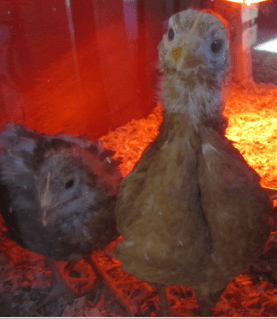
This is one of the baby girls now. I call this the "awkward teenage week" when they have some feathers but some fuzz. Still, they are cute beyond all reason, right?
This is one of the baby girls now. I call this the “awkward teenage weeks” when they have some feathers but some baby fluff as well. Still, they are cute beyond all reason, right? And, it’s really soon to tell for sure, but I think they may even be smarter than our first babies. These girls are ISA Browns–a cross between Rhode Island Reds, which we have already, and Rhode Island Whites.

It’s all coming together for me. I might know the root of the “feed me individual bites” thing. It’s not going to be easy not spoiling those chickens. Maybe I just need to be okay with spoiling them.

On Making Pie

I spent many years in search of the best pie crust recipe I could find, but it was only a couple of years ago that I realized why it was so hard to find a good pie crust recipe—I was trying to find a low-fat recipe. I know. I know. It was a big mistake.

After many, and I do mean many, failed pie crust attempts (all of which my sweet husband ate and encouraged me by saying “It’s not too bad” or “It’s pretty good”), a couple of years ago, I found a recipe that I could adapt well, and it was not low fat.

The biggest lesson I learned in my quest for good pie is this one: It’s just going to have some calories, and that’s OK with me.

Now, calorie-wise, I can’t afford to eat a lot of pie, and some might argue that I can’t afford to eat any pie. But there are some things in life that are just worth it. To me, a good piece of pie is worth the calories. I’m totally willing to walk a few extra miles or even skip lunch for a good piece of pie. I feel like this says a lot about me as a person. This is where I am in my life. Pie is important.

So, here’s the recipe for the crust, and I have some tips below. This recipe was adapted from a couple of pie crust recipes but most closely with one from Allrecipes.com.

Makes One Pie

A Top and Bottom Crust

Ingredients:

2 cups flour

1 cup butter-flavored shortening (or 1 cup butter)

*As a note on this ingredient, I actually use a little more than ¾ of a cup of the butter-flavored shortening. It’s like somewhere between the ¾ of a cup and a full cup that is the perfect amount, at least we think so.

1 Tablespoon white sugar

½ teaspoon salt

¼ cup ice water

½ egg

*This gets tricky, but you can do it.

½ Tablespoon white vinegar

Directions:

Mix all of your dry ingredients together, and let your water sit with some ice in it to get really cold. Add in the ¾ cup to 1 cup of butter-flavored shortening or butter. Cut it in, so everything looks crumbly.

Now, add your wet ingredients. Add your ½ egg. I have added just about a whole egg before. It still works. Add your vinegar and water (just take out your ice).

Mix everything together with a wooden spoon—but not too much. You just want to mix it enough to work with it. The original recipe says to let the dough sit in the freezer for some hours before you work with it, but I never do. I can never plan that far ahead.

Cut your dough into two pieces, one for the top and one for the bottom. Roll it out pretty thin-like. When the dough is thin, it comes out flakier, I think, which is good to me.

Of course, you can put any kind of deliciousness inside your pie crust. I prefer fruit pies from fresh, sweet fruit and just a little sugar and cornstarch. If you’re going this route, just fill up your pie shell with the amount of fruit you like. *Please note that you will need an official recipe for the filling if you go with apple pie, but I just stick things like strawberries, raspberries, peaches, etc. right in there with a little bit of sugar and cornstarch.

Cut some kind of hole in your topic crust or you can make the lattice top. When I have more time, I make the lattice top. When I am in a hurry, I cut a heart into the top crust. Pinch your edges together. You can get fancy with this, but I have no skill in this department.

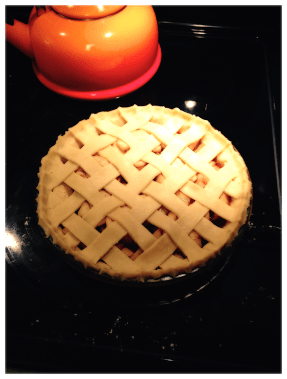
apple pie
This is an apple pie with a lattice top pre baking. I am still searching for the best filling recipe for apple pies, so if you have one, please share!

Cooking time and temps totally depend upon your oven I have found. I have made some big mistakes following recipes on temperature and time, but with a fruit pie, I recommend 400 degrees and that you start checking and turning (if you have a sad, uneven oven like mine) at about 20 minutes. The trick is to cook until the crust is golden brown on the top.

Now, here’s the story of and recipe for the best pie I ever ate in my whole life.

Our neighbor grows raspberries every summer, and they are lovely. The raspberries in the grocery store cannot compare, as the ones from our neighbor’s garden are so flavorful. And, thankfully, every year, she shares said raspberries with us. I am always making raspberry/blackberry pies with those raspberries, and they are delicious. But, this year, I decided to get some super ripe peaches and make a raspberry/peach fruit pie with this delicious pie crust recipe.

I used about 2 cups of raspberries and close to the same amount of peaches. The peaches were bought at the local grocery store, but I put them in brown paper bags and let them sit in the basement until they were so ripe I could hardly hold one. Then, I cut them up and put them in the pie. I added ¼ cup of sugar and a tablespoon of cornstarch. I cooked the pie about 25 minutes, until it was golden brown.

This was my first go at this pie, so I wasn’t sure. Still, I was hopeful. But, after dinner, everyone was full, so no one at a piece of my raspberry/peach pie. But I didn’t forget about it. No, I didn’t.

That night, before bed, I announced that I was having a piece of the pie. My husband said he would have one “maybe later,” so I proceeded on my own. Upon taking the first bite, I was frozen. My taste buds were overwhelmed with deliciousness. I ran to the living room and told my husband he was going to have to try this pie.

I said, “I could be wrong, but I think this is the kind of pie you win awards for.”

So, of course, he had to try it. It turns out I was right. It was amazing; he said he thought so, too. He agreed it was the best pie he had ever eaten.

So, when you make pies like that, you have to eat pie sometimes. I hope you enjoy this recipe. I hope you get some fresh raspberries and ripe peaches this summer and get to make a pie that might literally bring you some joy.

Cherry Pie image
I have used this picture before, but it was kind of critical this week. This is my classic “I’m in a hurry” pie crust top. But I always cut a heart into the top (unless it’s National Pi Day, and I use a Pi symbol) because my pies are made with love.

Pie brings me some joy. Thankfully, in the summer, we are all working so hard and so long in the garden and with the animals that we can afford the extra calories.

Life’s too short not to have some pie, especially pie made with love!

On Learning to Live More Frugally

Even just five years ago, I don’t think I would have been ready to say that I wanted to make a lot less money and live my life differently. I think I’ve wanted to live more simply for a long time, but for many years, I was just too afraid to make the change, too afraid to go backwards in the money department and taking that big pay cut.

But, as you know, I finally got brave enough to give Thoreau’s advice about wanting less and working less a chance. But I am such a slow thinker or thoughtful planner (I think I prefer the latter) that I didn’t just jump into this without a lot of planning.

I have been studying how to live more frugally for years and practicing for at least a year before we decided we could live on half the money we had been living on before. Yes, half. Actually, a little less than half. No matter how you slice it, you can really feel living on half the money you used it, so we practiced a bit before we took the plunge.

We started slowly after reading about different ways people were finding to live more frugally, as the advice seemed to be everywhere. But, I think, along the way, after practicing the advice and getting a sense of what would work for us, I learned that I actually really liked living frugally, and I was learning so much along the way.

This week’s post is devoted to offering my own sort of advice related to living frugally and what worked for our family in the hopes that you might see one thing listed that could work for you, save you money, and give you a bit more time.

But, before we begin, here’s the one big lesson that is important to share before reading my list or any kind of list, for that matter: It’s helpful to start with one small thing; practice it; live with it a bit to see if you can really live it.

I think, for most of us, or at least for someone like me, taking baby steps is critical.

OK, finally, my list…

1. We cut our cable. In our case, it was actually satellite television we cancelled, but it saved us about $100 per month. I feel like they should be paying us to watch all those commercials anyway.

2. I learned how to shop differently. This one was on me, and I learned new habits because I really wanted to learn new habits. I had grown up in a culture in Texas in the 1990s where shopping was like a way of life, and I started to realize how wasteful it was. So, now, there’s no “going shopping” unless we really, really need something, and we try to buy things that will last as much as possible. This means paying more for quality items, but I estimate that we save about $75 per month using our new system of buying quality items—just far fewer items.

3. As much as we wanted to save money on food, we decided that this was one area we could not be “cheap” about because of our health, so we had to get creative. I am a firm believer that most Americans should probably be spending more money on food, not less, so trying to be frugal about food is more of a challenge, but we have found a few key ways to save money:

  • We quit buying grated cheese. We now buy big blocks and grate it ourselves. This adds time to my cooking rituals, but we eat a lot of cheese, so this saves us quite a bit of money. This is a really small thing and may not seem worth the time, but I think it’s a pretty good plan. I figured it out, and in most cases, we end up with three times the amount of grated cheese for the same price.
  • We make our own bread and snacks. I realize this is one that takes some time, but if you have the time, you will save money and have healthier food for you and your family. Plus, there’s nothing better than seeing your six year old devour his “favorite pumpkin muffin” you just made. This one is cost saving tip that can add time, but, for me, this is how I want to spend my time.

    Cherry Pie image
    I don’t want to sound like I’m bragging, but I have mastered pie crust. There will be a whole post later devoted to the recipe. It feels really good to make a delicious pie to share with my family.
  • We grow our own food. Buying local and organic is important, but when you want to quit your job and will be making less than half what you used to, you have to figure something out. For us, it was growing our own food. The seeds are inexpensive, the rain and sunshine are free, and some foods provide seeds for the next year as well. This has been a huge savings for our family. Even if you have a small outdoor space, you can grow some key foods relatively easily, and you get the taste and health benefits as well.
  • I use my tea bags twice. I love tea and usually drink two large cups of chai tea every day. I used to use two tea bags per day. Then, I learned a trick from a friend (you can learn a lot of frugality tips from Mainers) to save the tea bag and use it twice. It totally works, and I spend half as much money on tea.
  • Finally, my best strategy in the grocery department is to always eat our leftovers. This was huge for us because I was so bad about letting leftovers go to waste. But we totally try to live by the “waste not want not” rule, as cliché as it sounds. I have found that, at the very least, leftovers for lunch saves us quite a bit on our lunch budgets, but, sometimes, I am able to get entire supper meals out of the leftovers, which can mean a big savings. Plus, it’s good not to waste food. I mean, think about what your mother used to tell you to get you to eat your dinner.

4. I quit buying products for my face. So part of this one is going to be difficult for most women I know, but I quit wearing makeup unless there is a special occasion. I grew up in Texas where this was just not the way of things, so it actually took me some months to get used to my face without makeup. That sounds weird, right? I had to get used to my face without makeup. It does save me a lot of money, as I was buying some pretty expensive cosmetics.

But here’s the easy part of this tip: I started use aloe vera straight from the plant for my skin care. I can’t tell you what a miracle worker pure aloe really is! I have always had hormonal acne, and I was spending $50 per month on my facial cleaners. I now spend $0 per month because I bought a few plants at the store for about $3 each and just grow my own skin care.

aloe plant picture
This is one plant in my little aloe garden. You can see I have taken some leaves for my skin care needs, but the plant continues to do well.

I discovered this little life hack when my poor husband was burned with chemical burns from a cement adventure this summer. The aloe healed his wounds better than anything else. So I researched the benefits of aloe and found that it also helps with acne. I’m here to tell you it does! It works much better than the expensive stuff I was buying, is totally natural, and, in addition to clearing up any acne, makes my skin look softer and shinier.

I also shared this one with my teenage son, whose skin is so much better on the aloe. Plus, we were spending $50 a month on his skin care as well, so the aloe has saved us quite a bit of money—and it works beautifully.

5. We changed our holiday habits. Let’s face it. Our culture shoves materialism down our throats during any and every holiday season, and it can be hard to go against that. But, this year, we have no choice, and we started with Easter. Here in Maine, Easter seems to be a pretty big deal, almost like Christmas-lite. The Easter Bunny doesn’t just leave eggs. He leaves presents! But, this year, we had to make the change.

I purchased a used Pottery Barn Easter basket on E-Bay that we have had for four years, which serves as my youngest son’s Easter basket every year. It’s well made and eliminates the need to buy more “stuff” like an Easter basket. Then, this year, there were no presents. We didn’t even do plastic eggs.

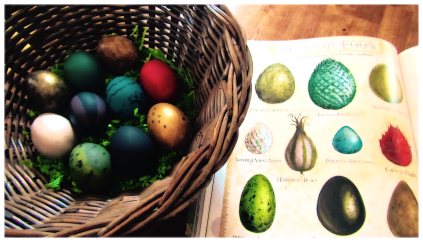
We have chickens, so I decided to do something creative with those free eggs. We had been reading the illustrated Harry Potter and the Sorcerer’s Stone (which I highly recommend), and I saw a beautiful illustration of dragon eggs and decided to use non-toxic craft paints, some of which we had. I did have to buy $2 in additional colors, and we just did our best to make dragon eggs. Our whole family enjoyed this!

dragon eggs for easter
I’m not nearly as crafty as I would like to be, but these turned out just fine. Having dragon eggs definitely added some excitement to the Easter egg hunt!

Now, I have to be honest. My youngest was a little disappointed that there were no Easter presents this year, and I did feel a little guilty when I saw all of the amazing Easter present pictures on Facebook. But this is it for us. My youngest has a tendency to be a little more materialistic than I would like anyway, so I think we’re all going to be learning some important lessons as we make this transition.

Easter was our start. I’ll let you know how we do at Christmas. And Halloween’s going to be tough too, I think.

So these are my big frugality “tips” for this week. All of these may not be for you, but I am telling you, I think you should at least give that aloe a go. It’s a cheap little miracle.

As for the rest, everyone does have to find their own path, but I am enjoying our journey into frugality—at least for the most part. I just need to become more of a “maker,” and I am planning to start knitting lessons soon. In the meantime, I guess we’ll have to buy our socks and hats, but I can totally make some dragon Easter eggs and an awesome cherry pie!

Oh, and if you have any frugality tips, please share them here. I am, as always, a work in progress.